A prologue is not a review. It is to be read before watching in order to provide the tools for understanding the film.
I. Jean Epstein
Epstein originally studied to be a doctor, taking biophysics and medicine at the University of Lyons. Passionate about the arts, he turned his attention to literature and literary criticism, writing a treatise on theory of art. He included only a single chapter on cinema.
Shortly after, he turned his whole attention to cinema, publishing Bonjour Cinema (1921), his contribution to film theory when it was yet in its infancy. His theory of cinema developed throughout his career, but remained influenced by the writings of Louis Delluc.
Delluc was a disciple of Lumiere, a theorist in his own right, and worthy of some note as being perhaps the first filmmaker to treat film as a medium for art. Epstein worked with Delluc for some time before going on to make his own films, beginning with Pasteur, a biopic of Louis Pasteur.
It was after this first biopic that Epstein attempted to put his theories into practice, starting with Coeur Fidele, which showed influence primarily of Delluc and Abel Gance. Working with Luis Bunuel, he soon began adapting two Poe stories, "The Fall of the House of Usher" and "The Oval Portrait" as Chute de la maison Usher. Bunuel left production early, however, being unable to agree on how faithful to remain to Poe. Bunuel stated in an interview that Usher is all Epstein's.
II. Situation and Impressionism
Epstein's fidelity was not to the narrative of Poe's story, but to the themes and motifs. In the story, Roderick and Madeline are brother and sister; in the film, they are husband and wife. In the story, the narrator character is Roderick's age; in the film, it is a decrepit old man.
Epstein's disregard of Poe's narrative was motivated by his distaste for narrative in general. His theory of cinema was derived in part from Delluc's theory of the photogenic. Where Delluc believed that even the most atrocious film could be salvaged by a photogenic object, especially a pretty face, Epstein's view of the photogenic is more complex. For Epstein, the photogenic is the essence of cinema itself and narrative is just getting in the way. "I want films in which not so much nothing as nothing very much happens," he wrote. He wants situations rather than stories. Situations where the photogenic can be captured by the camera.
For Epstein, the photogenic is "any aspect of things, beings, or souls whose moral character is enhanced by filmic reproduction." And the only aspects of things, beings, or souls whose moral value can be increased by cinema are mobile and personal.
By mobile, Epstein means that the object is undergoing variations in space-time, that is, both space and time. Cinema has a fourth dimension that is time and any film that is not 'drawing' in the fourth dimension is a failure.
By personal, Epstein means that the object, whether a person or a thing, has significance transcending the surface, a spirit as it were; and this is a significance earned by its past and predictable future. Epstein gives the example of a close-up of a revolver, which is not just a revolver when so selected by the camera, but is revolver-character insofar as it is itself the impulse to crime, to self-defense, or to remorse for crime. Everything so selected (in a good film) by the camera is made a character thus. Or some possession with sentimental value: it has sentimental value by its history, the memories and emotions attached to it--that is its personality.
While it is only the camera lens that has the power to reveal the photogenic, according to Epstein, the camera requires a director behind it with true personality--an artist, in short. And this artist lends personality to the photogenic discoveries made with the camera. What results is that, "matter is molded and set into relief by personality; all nature, all things appear as a man has dreamed them; that world is created as you think it is... Time hurries on or retreats, or stops and waits for you. A new reality is revealed, a reality for a special occasion, which is untrue to everyday reality..."
Cinema is thus a dreamworld, for Epstein. A machine-produced dream, made up of situations. And these situations of the morally enhanced (deified, archetyped) aspects of mobile, personal reality. A film is thus like a Symbolist poem for Epstein, made up of images endowed with layers of meanings to embody absolute truths and personality; and like a Surrealist painting, magnifying the unseen, unconscious aspects of things in the image.
III. "Based on themes by Edgar Allen Poe"
Poe was an important figure to the Symbolist poets and painters, for the reason that he gave pre-eminence to the inner life of his characters much as the Symbolists sought to render reality representative of the inner. Poe's philosophy of composition involved choosing objects and situations in the real world that reflected the inner life of his characters, hence the raven in "The Raven" and the beating heart in "The Tell-Tale Heart."
Given Epstein's theories of cinema, he and Poe are a perfect match. Epstein engages not Poe's narratives, but his world of symbols, the objects that are invested with the photogenic: the oval portrait with the soul of the woman it depicts trapped inside is here Roderick Usher's obession; the pendulum of the grandfather clock is Poe's pendulum from the pit; Madeline Usher is buried in the tomb of Ligeia, and so on to much of the apparently insignificant details.
The framework of the tale, "The Fall of the House of Usher," provides the grand situation Epstein has to focus on. Enveloped in this situation are all the objects--people and things--to express a surreal dream of Gothic tropes. It is the minds of Poe, his protagonists, and of Epstein, that become the spirit of the images; for which reason did Epstein claim his film is "Based on the themes of Edgar Allen Poe." Whatever infidelities to the narrative(s) Poe constructed are balanced by the fidelity to Poe's themes and vision.
-
Watch the film here: http://video.google.ca/videoplay?docid=9172687785667332165
Enjoy.
Help make this site more interesting through discussion:
Prologue to Epstein's Chute de la maison Usher
Author: Jared RobertsThe Monster (1925)
Author: Jared RobertsThe Monster, directed by early master of terror and possible murderer of Thelma Todd, Roland West, is--in terms of sheer ability to create suspense and terror--probably the most effective silent horror film I've ever seen. This is due both to a particularly menacing performance from the great Lon Chaney and a good script.
After a shocker opening in which a strange Hobgoblin-like man purposely causes a car crash and drags away the body, the film begins as a lighthearted comedy amongst its protagonists. In fact, the intertitles in the first fifteen minutes are quite amusing, with lines like "[the] detectives deduce a few deductions" and "Johnny Goodlittle -- he has ambition, which in Dansburg is as bad as having eczema." This comedy section introduces us to the characters, Johnny the meek amateur detective, Amos his wealthy, pompous boss, and the woman they both love.
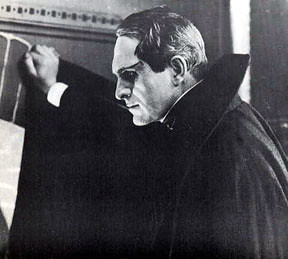
By chance, all three of them end up trapped in an old sanitarium, which is being run by the genuinely frightening Dr. Ziska (Lon Chaney)--whom we meet in an amazing entrance. Ziska, it takes a second or two to realize, is evil. He's a mad scientist and a hypnotist ta boot. He keeps the creepy Hobgoblin Rigo in a trance to do his bidding. Another servant is an enormous Arab who seems to have just been spit out of an Arabian Nights tale. A third servant, Dan, is too insane to even be dangerous, though he tries his best.
At this point The Monster becomes an old dark house film; a highly successful one, in fact. Dr. Ziska keeps the group locked in the house and gradually tries to manipulate them for ends we just know must be sinister. In the meanwhile, the group tries to find a way out of the house before it's too late.
Every time I've had a chance to see one of Roland West's films, the same thought has occurred to me, "How was he doing this so long ago?" In many of the things West pulls off, he is years, decades ahead of his time. Johnny's duel with Rigo is the most stand-out moment in this one, taking place suspended on power lines.
The film is stylishly shot, obviously taking some hints from German expressionism. The actors are quite good, especially Lon Chaney. The heroes are likable; the villains are truly menacing and interesting. Most importantly, though, is that the suspense really works. It's the only silent horror film that ever successfully made me feel terror and it succeeding in doing so several times.
I highly recommend viewing this one if you get the chance. It has played on TCM, which is where I got my copy from. It's also available to download if you look. This is especially a must for Lon Chaney fans.
Categories: 1920s, horror, silent Wednesday, December 24, 2008 | at 9:41 AM 0 comments
Wolfblood (1925)
Author: Jared RobertsWolfblood: A Tale of the Forest (1925)
Chesebro, you ask? Here is what Wikipedia yields,
"George Chesebro (29 July 1888 – 28 May 1959), was an American film actor. He appeared in over 400 films between 1915 and 1954. He was born in Minneapolis, Minnesota and died in Los Angeles, California."
This is true. He was a prolific actor. He had a moderately handsome face and often took the lead in silent westerns and serials.
Of interest to us, however, is his sole outing as a director, Wolfblood: A Tale of the Forest. This is perhaps one of the most evocative film titles if the silent era. How does the film measure up?
The film concerns a logging company foreman, Dick Bannister, working in Northern Canada. Across the river is a rival logging company that resorts to sinister means to keep the upper hand. One of those means is shooting lumberjacks in the legs to prevent them from working!
After one such incident, Bannister decides to call the owner of Ford Logging Co. to get him to come in with a surgeon. It turns out the owner is a pretty young heiress and her fiancee just happens to be a surgeon (whom, we're informed, is so rich he never performs actual surgery, but treats it as an academic discipline).
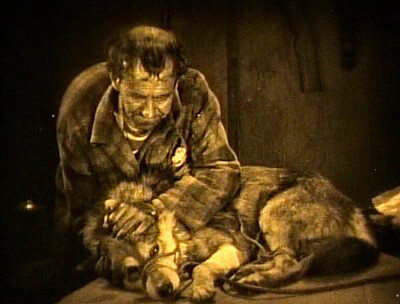
The owner and the surgeon show up just when things are getting even more heated with the enemy foreman, Devereux. Devereux has Bannister beaten so badly that he busts an important artery. The only blood nearby is wolf's blood. Our surgeon, being so learned, knows it's possible to use animal blood, though the side-effects are unknown.
With the wolf-blood coursing through his veins and suffering from a concussion, Bannister becomes obsessed with the notion that he's a werewolf and wants to rejoin the pack--the pack of Phantom Wolves.
Lupine motifs increase as we bound towards the end, though it all resolves rather neatly, I'm afraid to say.
Wolfblood not a bad film. It has no great visual style like you would get from German horror of the time. The story itself bubbles down to a Gothic-inspired, lumberjack melodrama. However, if you enjoy silent films in general, the one hour is no waste of time. And it is perhaps the first instance of an attempt to base the werewolf ('Loup Garou') legend on science.
(For horror completists, Wolfblood has the distinction of being the oldest surviving werewolf movie. There was, in fact, a 1913 Canadian werewolf movie called The Werewolf that was destroyed in a fire.)
PHOTOS:
This wolf is thinking, 'I knew I shouldn't have volunteered; I hate needles.'
http://farm4.static.flickr.com/3067/3068013916_555520e208.jpg?v=0
Scruffy Canadian meets a not-very-threatening wolf. Oh dear.
http://farm4.static.flickr.com/3184/3068013686_8d06c44a6c.jpg?v=0
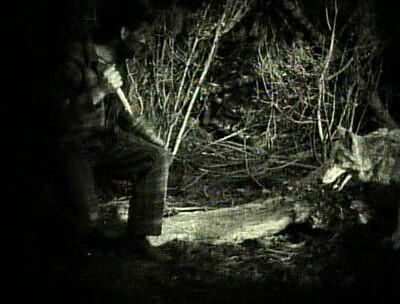
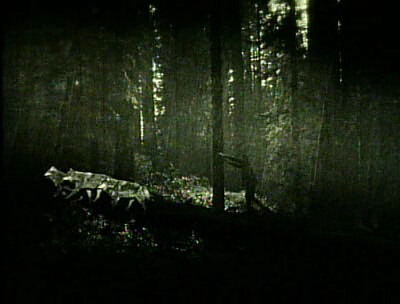
Bannister chasing the Phantom Wolf Pack.
http://farm4.static.flickr.com/3041/3067175981_975fdb7279.jpg?v=0
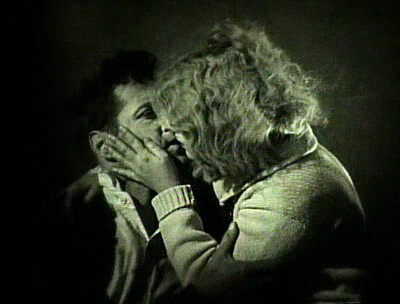
A kiss,
http://farm4.static.flickr.com/3027/3068013376_e159bb8358.jpg?v=0
The Silent Horror of Otto Rippert
Author: Jared RobertsOtto Rippert (1869-1940) had a directorial career spanning from 1913 to 1924. Out of his dozen or so feature-length films, he directed four horrors that are either lost or simply not available.
1. Homunculus - Homunculus is a six part serial dealing with the creation of an artificial man. Before The Golem, Alraune, and Metropolis, this film dealt with the theme of artificial life built from scratch. A scientists builds a homunculus, an artificial man; when the homunculus discovers that he is artificial, has no soul, and that true love can never be his, he is furious and uses his superpowers to begin a tyrannical reign of terror.
Early serials were often excellent, unintentionally avant-garde, like Louis Feuillade's Les Vampires and Judex. To my knowledge, Homunculus would be the first horror serial. It's a shame it isn't available.
Pictures:
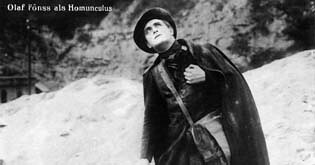
The homunculus
http://farm4.static.flickr.com/3139/3054722397_7c0cd65195.jpg?v=0
The homunculus shows his amazing strength
http://farm4.static.flickr.com/3225/3054722437_5e80e2a980.jpg?v=0
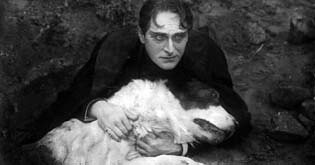
The homunculus rescuing(?) a child (Edit: It's very clearly a dog, what was I thinking?)
http://farm4.static.flickr.com/3177/3055557960_41bc7b9a1c.jpg?v=0
The homunculus, not looking terribly happy
http://farm4.static.flickr.com/3036/3054722461_209087e4a7.jpg?v=0
2. Das Verwunschene Schloß (The Haunted Castle) - There's not a lot available on this one. From what I can gather, a Count flees from something or other and leaves the castle without an heir. The castle is haunted and casts strange lights over the village. A farmer guards the castle and is trying to get an heir from the Count's daughter. If anyone can clear this up, please do. Werner Krauss (who played Dr. Caligari) is in this one.
Pictures:
(Alas, none could be found.)
3. Totentanz (The Dance of Death, or Danse Macabre) - Written by Fritz Lang, this is unfortunately a lost film. Doug Sederberg writes in the IMDB plot summary,
"In this apparently lost film, a beautiful dancer's sexual allure is used by an evil cripple to entice men to their deaths. Falling in love with one of the potential victims, she is told by the cripple that he will set her free if her lover, actually a murderer himself, survives and escapes a bizarre labyrinthe which runs beneath the cripple's house."
It sounds fantastic! It's a shame it's lost. Even if it weren't lost, would it be available?
Pictures:
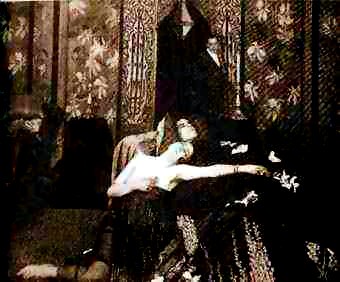
A woman (the dancer?) and a man lie slumped, another man is entering from behind
http://farm4.static.flickr.com/3004/3054722531_462c0384d8.jpg?v=0
4. Die Pest in Florenz (The Plague in Florence) - Another Fritz Lang script, this time adapting Poe. Again, I give you a synopsis from Mr. Sederberg,
"Suddenly appearing in Florence, an evil seductress causes Cesare, the city's ruler, and his son to both fall madly in love with her. The son, killing his father before an order to torture the woman can be carried out, then turns the city's churches into dens of sexual debauchery. Acts of evil and corruption continue unabated until the arrival of Death, who brings with her a horrible plague which she is about to loose upon the city."
This film, which also sounds amazing, is still extent, but is simply not available. A Fritz Lang-penned German Expressionist silent Poe adaptation and it's not available? Where is justice in the universe?
Pictures:
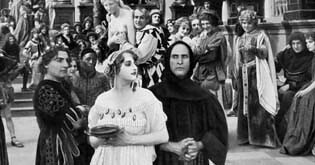
Death (or some creepy monk) walks with a young lady:
http://farm4.static.flickr.com/3271/3054722277_88426b79a3.jpg?v=0
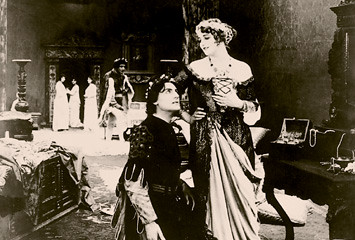
Cesare's son and the seductress? Note the deep focus, long before Citizen Kane.
http://farm4.static.flickr.com/3019/3055557852_c2a08858a2.jpg?v=0
[Fritz Lang also wrote a third script for Otto Rippert, Die Frau mit den Orchideen (The Woman with the Orchid)--also starring Werner Krauss--but it's a melodrama, not a horror.]
Maciste All'Inferno (1925)
Author: Jared RobertsREVIEW
Cinema's first action hero, the Italian Maciste, makes his first descent into the underworld in Brignone's Maciste All'Inferno, a thoroughly entertaining and inventive silent.
Maciste is a gentle giant, strong and virtuous. Some emissaries, dressed in capes, tophats, and goatees, are sent up from Pluto, the King of Hades, to lure Maciste into Hell.
Though the trickery succeeds, Maciste is free to leave Hell within three days--unless, of course, he's kissed by a female devil. The females in Hell are all too willing, never having seen a man as big and strong as Maciste before.
When Maciste succumbs to the allures of the sexy demonesses, not only does it seem he is trapped in hell as a devil himself, but, as it so happens that Hell is in the midst of a civil war, he must also lead an army of devils to defend his new lord Pluto from the usurper. Will Maciste ever get out of hell?
If you're trying to imagine this plot carried out in a silent film, you no doubt have a slight notion of how weird this picture is. You don't know the half of it. Devils who get their heads knocked off by an angry Maciste play football with them, an enormous Satan plucks human souls from the hellish landscape to munch on, and a fire-breathing dragon offers Maciste a ride--these are just a few of the spectacles one has to look forward to in this film.
This is one of those rare cases where an impressive, expensive production (for its time) results in a truly fine, inventive film, not unlike Fritz Lang's Nibelungen a year earlier and Murnau's Faust a year later. Yet, there is no denying this is an early special-effects picture, invested primarily in exciting visuals. The scenes of the underworld are exceptional visions of hell. Stalactites hang down sharply over damned souls labouring in chains. Dozens of extras in unusually good devil-imp costumes roam, usually attacking Maciste in droves.
While Maciste All'Inferno is as much fantasy-adventure as it is horror, it has a lot to offer horror fans. If you like sexy devil girls, a hero who knows how to kick ass, fiendish monsters, hellish imagery, as well as a few laughs along the way, try get your hands on this one.
FACTS
Director - Guido Brignone
Writer - Riccardo Artufo, w/ credit to Dante Alighieri.
Starring - Bartolomeo Pagano, Elena Sangro
1925
95 min.
WHERE TO GET IT
Unfortunately, it is not available on a proper DVD in North America--I don't even know if it's available in Italy. Don't let that stop you, however. It is quite available on eMule in a quite good, quality avi.
UPDATE: Capkronos has informed me that the Nightmare Worlds 50 Movie Collection contains this film. This box set is easy to find.
TIDBITS
Maciste All'Inferno is the film that made Fellini decide to be a director.
Was an influence on Mario Bava, such that he paid tribute with Hercules in the Haunted World.
Riccardo Freda remade it in 1962, which I reviewed earlier in this series.