Filmmakers of any sophistication, when embarking upon a remake, must take firm hold of two major horns: Agon and Interest. Agon is competition, the struggle of one artist to assert his uniqueness from and superiority over other artists. Not only is the artist in competition with artists of his own generation, but also with the artists of previous generations. If he does no more than what they did, he is doomed to unoriginality. He must outstrip them. Any American horror filmmaker in the 2000s must be in an agonistic relationship with John Carpenter. Carpenter is one of the best horror film artists. Howard Hawks used to say one need make only a single great film to be a great director. Carptenter has made at two great horror films, Halloween and The Thing. Rob Zombie, one of the latest generation of horror filmmakers, has taken up agon in the most serious way possible: he's remade the greatest film of the Master, Halloween.
Taking the agonistic angle seriously is important for taking Zombie's Halloween seriously. Much discussion of the film has involved the alterations Zombie made to Carpenter's original vision. While I'm certain Zombie is respectful, even admiring, of Carpenter and his film, he's a serious artist and his relationship to the original Halloween will have to be one of rivalry. Rather than viewing the alterations Zombie made as blasphemous or an ignorant step down, it's worth seeing them in the context of a new artist asserting his own voice.
To illustrate my point, let's take an important scene from the film: Michael's first kill. Much of what is used and revealed late in Carpenter's film is given away in this early moment in Zombie's film. By 'later' and 'earlier' I don't mean merely in terms of narrative progression, but also the progression of Michael's existence. Carpenter saves most of what we see and know of Michael until he's an adult. Zombie deliberately transposes those behavioural traits to his child-Michael. Dr. Loomis (Malcolm McDowell) arrives in the principle's office to tell Michael's mom that he's a sociopath. While he's talking, Michael slips away to stalk and murder the bully who got him in trouble. While Michael slips away, the famous Halloween theme (composed by Carpenter) begins to play. The use of this music at that moment is very important. So is, moreover, the stalking of the bully, which deliberately quotes the stalking of Jamie Lee Curtis in the original film. There are a few points being made. One is that Michael's behavioural traits began young and, to some extent, chastising Carpenter for neglecting Michael's childhood. More strongly, however, we're being told that Carpenter's Michael is child's play compared to Zombie's Michael. Carpenter's Michael is totally expressed and used up in that childhood moment. Carpenter is out of the way and left behind: now let's see Halloween for grown-ups.
That message is compounded when, a little later, the boyfriend of Michael's sister wears the classic mask from Carpenter's Halloween and the teenage girl is not the slightest bit terrified. The old Michael Myers is no longer a sufficient force for terror. He has become juvenile. I doubt all of this is intended to be a disrespectful statement by Zombie; agon is, as I say, necessary in the artistic order. Zombie is asserting his vision against the Master. His is a unique authorial voice and it must be in competition with its most powerful influences.
These influences are not limited to John Carpenter's films. The sheer number of cameos from the horror and exploitation genres are indicative of an agonistic struggle with the whole of horror history. Multiple things can be true at once. If one asks, "Why is the water boiling?" the answers "Because I want tea," "Because I put it on the stove," and "Because the water has reached a temperature of over 100 degrees centigrade," can all be simultaneously correct. Similarly, claims that Zombie is adding cameos because he's a horror fan and because he wants to please horror fans are very likely true. But as a filmmaker and horror fan, he is in a position of knowing the history of horror cinema and wanting (no doubt) to be a unique presence within the genre. After all, how can one sincerely like a genre and not want to contribute something meaningful to it? His casting of cameos is in some sense his way of appropriating the horror tradition for his own voice.
So much for Agon. Interest is perhaps more important. As when a play is directed by two different directors, the look and weighting of sympathies may be entirely different, a remake naturally centers upon what interests the filmmaker. The original Halloween completely glosses over Michael's childhood and the relationship between Michael and Loomis. Zombie takes a very keen interest in both of these points and in doing so he brings out a lot of valid questions that are lurking in the back of Carpenter's Halloween. Despite opposition to questioning a masterpiece, some of the questions Zombie raises do suggest some flaws in the original Halloween. Or rather, one major flaw: depicting Michael as a supernatural evil, or 'soulless'.
For Zombie, Michael's depiction as pure evil is entirely attributable to Dr. Loomis. This is a point I had never considered in all the times I watched Halloween: that Dr. Loomis should be doubted. Why should we trust Dr. Loomis? He's a clinical psychiatrist who declares Michael the embodiment of evil and ultimately shoots him. Zombie's Halloween turns a very critical eye on Loomis. Loomis comes across as one of those 'celebrity shrinks' who take high-profile cases in order to get juicy book deals. The first frame of the film is a quote from Dr. Loomis explaining that Michael is a soul that's escaped from the pits of hell. I don't recall seeing that one in the Diagnostic and Statistical Manual of Mental Disorders. What follows this quote of Loomis's is a childhood that puts the sympathy on Michael. Yes, Michael is doubtless a sociopath. He's also a sweet boy who isn't getting the nurturing he needs to deal with his problem constructively. His life is full of humiliations that push him further and further within himself. The one person able to reach him and help him is his mom.
Unfortunately, Dr. Loomis prevents Michael from spending any significant time with his mom. Michael repeatedly tells Dr. Loomis that what he needs is to go home. Dr. Loomis not only ignores him, but begins to attribute Michael's worsening condition to something sinister within him. Dr. Loomis's major problem is that he takes his failure as a psychiatrist personally. This is typically masculine. The more some system doesn't work, the more aggressively a man will apply it to make the thing obey. Of course, the mind doesn't work that way. Rather than question his training, Dr. Loomis questions Michael. If Loomis is failing, Michael must be something Other, something evil that the system isn't equipped to handle. When Michael decays, Dr. Loomis doesn't take this as proof he has been mistaken in his treatment, but as proof of what he's been saying all along, that Michael is a monster. When Michael becomes pretty much untreatable, Loomis abandons him and writes--wouldn't you know it?--a bestselling book declaring Michael pure evil hiding behind angelic features. He uses a photo of Michael, a sullen-eyed boy (Daeg Faerch), to prove that Michael has no soul behind his eyes. Really, all one sees in the picture is a tired and lonely boy. The evil is purely in Loomis's mind. That is what Rob Zombie brings out and it is a brilliant point.
Michael is not, however, a totally sympathetic character. Zombie's decision was simply to show that he is a sociopath demonized by a crackpot psychiatrist, not a demon psychologized by a decent psychiatrist. Michael's behaviour certainly doesn't earn us much sympathy. Quite the opposite, Zombie is careful to let us see he is a merciless killer. We just understand that he's a product of human stupidity, not of satanic intervention.
Nearly an hour into the picture, Michael finally escapes from the mental institution and the events of the original Halloween take place until the showdown with Laurie Strode (Scout Taylor-Compton). If the moments of Agon I described are promising a more gruesome, more frightening, more horrific picture, they are only partially correct. Certainly Zombie's Halloween is more horrific. Michael is described as a sociopath who enjoys watching things suffer. The camera of this film is like Michael: it lingers upon the sufferings of the characters. Carpenter's kills were quick. Zombie's kills, much more realistically, are protracted and agonizing (no pun intended). There is a lot of blood and the violence is unpleasant. The film is also quite scary where it ought to be scary. The problem is that the film is also, in these moments, tedious. I have no idea what it's like to be in such a frightening state of affairs and I hope to never have an idea, but I do know when I watch such scenes I prefer heroines who know how and when to stop whimpering, saying "please," and making typical horror movie mistakes. I won't go into them: if you've seen stupid horror movie behaviour, you'll have an idea of what to expect in these protracted chase/kill scenes. Where Zombie may have gone wrong is in trying to make these scenes too protracted, to the point that he must continue to provide excuse to keep the action going.
Coming from a musical background has also given Zombie a few additional talents. The film's sound is exceptional, occasionally realistic, occasionally ironic, and occasionally expressionistic. The use of diagetic music, such as KISS's "God of Thunder," Nazareth's "Love Hurts, and Blue Oyster Cult's "Don't Fear the Reaper" provide ironic yet insightful commentaries on the action or emotional states. For instance, Michael sitting alone on his front step is intercut with shots of his mother at her stripping job while "Love Hurts" plays. Sometimes the sound effects will stop altogether, distancing the audience from the reality of the action and creating a certain discomfort. Michael's mind has taken over the audio at these moments. In his moments of cruelty, he no longer hears the outside world. Perhaps this is what's happened to him permanently after years of Dr. Loomis. He can no longer even hear the pleas of his victims.
If Zombie wanted to distinguish his voice from Carpenter's and take on the Master, he can certainly be admired for putting up a good fight. His Halloween may not be quite as good or timely as the original, but it is on its own merits a damn good horror picture that provides some thoughtful critique of the original. (Godard discovered the role of critic and filmmaker could be merged by making films critical of other films. Zombie's Halloween is in that tradition. Halloween is about horror movies as much as it's about horrific events.) By this point, it's fairly safe to say Zombie has appropriated the horror tradition for his own authorial voice. But agon never ceases and complacency is never rewarded.
Help make this site more interesting through discussion:
Halloween (2007) - 3.5/4
Author: Jared RobertsThe Raven (2007) - 2/4
Author: Jared RobertsIn David DeCoteau's two subsequent Poe adaptations, House of Usher (2008) and The Pit and the Pendulum (2009), I was impressed by how DeCoteau mined Poe's wealth of symbols for psychosexual horror. The best Poe adaptations have exploited Poe's symbols, from Jean Epstein through Roger Corman up to DeCoteau. Both of those films were written by Simon Savory, who lends the films a playful creativity. The Raven, which was written by DeCoteau himself, lacks that playfulness. Poe's source material provides not symbols with which to explore the subconscious, but merely some motifs with which to decorate a mostly unremarkable '90s-style slasher.
What is remarkable about The Raven is how its slasher qualities seem to be a development out of a certain kind of drama pushed to its extremity. This is not to say DeCoteau set out to make a drama and accidentally made a horror film. DeCoteau's niche is horror. Though the horror precedes the drama actually, logically the drama precedes and erupts into horror in The Raven. The kind of drama The Raven pushes is what be called the bitch drama. This is not intended to be facetious. Nor is it intended to single out females. A bitch drama is a drama that consists entirely in the escalation of bitchiness between at least two people. The setting is usually a college, prep school, or high school. Moral ambiguity thrives in the bitch drama, as most characters perform some morally censurable acts. The film Jawbreaker is a good instance of a bitch drama. The film revolves around the three most popular high school seniors covering up a case of involuntary manslaughter. As one of the three has a conscience and as an outsider discovers what they've done, increasing acts of bitchiness exchange, mostly from the hands of Rose McGowan's character. Election and Cruel Intentions offer different and more mature forms of bitch drama. The essence is cruel scheming amongst young, proud, passionate people.
The Raven, too, is a bitch drama, even a homosexual bitch drama. But to be more accurate, it is the aftermath of a bitch drama. What happens to people like the Rose McGowan character of Jawbreaker if they never receive any formal discipline for their actions? What happens if the bitch drama is not resolved, but merely buried and ignored? The neat wrap-ups of bitch dramas make of their conclusions a false bottom. The Raven concerns two unpleasant young men, Roderick and Drake, who had one such bitch drama in prep school. Then they moved on, hoping to part ways perhaps. By unfortunate coincidence, they end up at the same college. What was buried bubbles up more vindictive and violent than ever: the bitch drama festers into a slasher horror. The catalyst is Roderick's graduation party, a masque ball he's hosting at a mansion famous for having been the site of a massacre during a masque ball years ago. Drake believes Roderick is hosting the party as an insult to him, though we only figure out why near the end. Now guests at the mansion are being murdered by a man in a raven mask with a blade shaped like a raven's talons. So this is the culmination of the bitch drama. Drake wants to ruin Roderick's party and issues death threats; Roderick is throwing a macabre, sinister party to offend Drake. Where bitch dramas sometimes include a death, The Raven is far beyond that. The cruelty has become a compulsion to kill all. The climactic reveal is a reveal of a bitchiness of truly perverse extremes.
The manner in which the slasher plays out is, however, unremarkable. There is a limited collection of attractive young men and a single female to be dispatched. Their personalities are scarcely if at all distinguished. And the raven is a most efficient killer. The protracted and aestheticized violence found in Italian slashers is not present here. The raven dispatches of each victim with a slash or two before they even have an opportunity to try running. The longest setpiece is also the most explicitly Poe-related sequence. The raven plays a recording of "The Raven" on phonograph while rapping on the victim's door. The possibility of an elegant setpiece proves as much a tease as the sex scenes.
DeCoteau's approach to softcore sex scenes, incidentally, is to always climax with the semi-removal of underwear. At least one of the men in the scene will have the back of his underwear flipped down to reveal his buttocks, but the front remains covering the genitals. This maneuver replaces penetration and orgasm in DeCoteau's films. This is peculiar, because it is unlikely sexually active people would be satisfied with this maneuver when it is just as easy to remove the underwear. DeCoteau's sexual setpieces, just like his violence setpieces, seem to end too soon and never engage the possibilities they raise.
There is very little of Poe left in the film. The raven itself is transformed into a psychopathological artifact of guilt that manifests itself physically in the raven costume. If there's anything linking The Raven with DeCoteau's House of Usher, it's the use of Poe's writing as a remedy for a character's psychological damage. But where House of Usher captured the rich subconscious of Poe's writings, The Raven remains mostly superficial. When one adapts a short poem like "The Raven", screenwriting invention is a necessity, of course. But one would expect an adaptation of a poem to at least be poetic. The most poetic aspect of The Raven is in the art design including all of the mansion's decor, the raven's costume and weapon, and the lovely, gothic matte that serves as establishing shot. There is also some poetry and some Poe in giving the raven the last word: nevermore.
Puffball (2007) - 4/4
Author: Jared RobertsAfter being out of the feature film business for a long time, master filmmaker Nicolas Roeg returns with a very weird film called Puffball. This title refers not to a furry woodland creature, but to a form of mushroom that grows into an edible, watermelon-sized, white ball, in appearance not unlike the moon. There are no knife-wielding midgets or horny meteorologists in this one, but it may be Roeg's strangest film yet. Roeg focuses a microscope on life itself, like the puffball both beautiful and hideously fungal in its monstrous, struggling messiness from conception to death in endless cycles. Roeg spares us not one intra-vaginal blast of semen. Not surprisingly, given a subject matter as broad as life itself, Puffball is a drama, a thriller, a comedy, a supernatural horror, a fantasy and more.
Puffball concerns an architect named Liffey (Kelly Reilly) returning to her roots in the Irish country. She's purchased an old cottage and is using her architectural skills to design her dream house where she will live with her boyfriend. Her closest neighbour is Mabs (Miranda Richardson), a middle-aged woman with a teen daughter, twin little girls, and a desire to get pregnant with a son. Mabs's mother, Molly, used to live in the cottage, where she lost a son in a fire. Now the slightly-unhinged woman uses pagan rituals to 'help' Mabs get pregnant with a replacement son. When the magic doesn't work--because magic is nonsense and all--Molly determines Liffey's taking over of the cottage is the cause. Not only that, but a defective condom leads to Liffey getting pregnant. That bitch! New and sinister magic will be required.
Now my tone there was slightly tongue-in-cheek and there's a reason. Despite concerning a lot of serious issues about procreation and having a few harrowing dramatic moments, there's something darkly comical about the attempts to witchcraft Liffey's child into Mabs. The rituals themselves are bizarre enough that even Mabs' teen daughter grows increasingly disgusted with them. And not only do the amateur witches keep getting misinformed as to the fluctuating state of Liffey's pregnancy, but Liffey seemingly gets pregnant by two different guys in a space of three weeks when Mabs can't get pregnant at all. While pregnancy-envy is a serious thing and Roeg does take it seriously, at the same time he recognizes how ridiculous it is when Molly calls Liffey a bitch for taking Liffey's own fetus from Mabs. As though there were a limited amount of fertility in this corner of the universe. But that's magic thinking for you.
Roeg leaves it ambiguous as to whether there is really any magic at work. He refines his famous cut-up shooting style here to emphasize the interconnectedness of individuals. This sense is strong enough that one would be justified asserting magical connections. For instance, Molly seems to be aware of the exact moment Liffey discovers her dead son's baby booties in the cottage basement. There are a few such instances and one wonders if it is real synchronicity or a result of Roeg's cutting.
Roeg also develops a level of symbolic interconnectedness. Superimposition links the interior of the cottage and the architectural models Liffey keeps with the interior of her womb. A mystical stone called the 'Well of Odin' is linked with the vaginal passage, perhaps with the aperture of cameras, and with some of the mystical notions expressed in the film. A total filmmaker, like Lynch, Roeg uses the soundtrack to advantage as well. Roeg also employs a sort of aural superimposition, whereby the ghostly sounds of a little boy are heard at certain moments throughout the film.
Then there are the puffballs. These too are linked to the womb both in the appearance of pregnancy and again by means of superimposition of a fetus over the puffball. The puffballs are visually linked with the moon, which is in the first shot of the film. The moon, of course, is tied to the motif of cycles, menstrual cycles, the cycle of life. This is what the film is ultimately about. Life is represented in all stages, from the fetus, through the little girls, the teenager, the fertile young woman, the middle-aged woman, the elderly woman and death. Then life starts again. It is all interconnected. It's not magic. But when one considers the sheer implausibility of any single human life coming to exist and the almost infinite odds against it, the result of that struggle feels quite close to magic. It's not a wonder something so mysterious could drive one to witchcraft.
But Roeg doesn't allow just one perspective on procreation to shine through. Liffey is flatly disdainful of procreation; the development of her cottage is her substitute for childbearing. Surely a woman needn't be defined by childbearing. For Mabs and her mother, procreation is everything. "Conceiving's what drives a man," Molly says. Mabs' sister Carol holds the truthful view that some women seem to just need to be pregnant and are less interested in the result of that pregnancy. We also get the perspective of medical science, refreshingly lacking sentimentality. Roeg takes no sides, but allows for a pluralism of attitudes toward procreation.
However, what will be uncomfortable is how Roeg's distance studies and scrutinizes the female human as an animal. The females, with their desires to be pregnant, their sexual urges, and many of their activities, sometimes come across as mere animals, silly, pitiable, and vulgar. This may say more about myself than the film, but at times I saw Liffey, and to a lesser extent Mabs, as just a 'stupid animal' rather than a person with the dignity that entails. Of course, procreation doesn't allow for a great deal of conventional dignity. Perhaps it is the conventional notion of dignity and not the 'aberrant' behaviour that needs to be done away with. Humans are animals, after all.
It might be evident by this point in the discussion that males don't play a major part in the film. That is correct. This is a matriarchal film, with most of the tensions between the women and all of the tensions about the women. Molly's view that "conceiving's what drives a man" almost seems true. They're the playthings of the women, used for sex and generally quite submissive. There are two exceptions. There is the doctor. But he's not in the context of a relationship. His presence is merely professional. He represents medical science in a manner tantamount to allegory. The other is Liffey's boss and mentor, Lars (Donald Sutherland). He seems to step in from another film and totally steals the scenes he's in. He's not connected with the plot, but rather with the themes. He has two brief-but-magnetic appearances as a sort of amateur mystic reminding Liffey and the audience that "we know nothing." He seems to represent a position neither masculine nor feminine, but somehow beyond both.
To some extent Puffball is also about place. Because life can't take place nowhere and where it does take place transforms a place. In fact, there is no such thing as place in a purely physical world, is there? There is space. Mathetical space occupied by objects. When conscious beings enter a space and begin to transform it, make it their own, it becomes a place. That place resonates with the people who have shaped it and influences its progress as new people inhabit it, feel it, and develop it in new ways. If there's one good thing that can be said about Liffey--an otherwise supercilious and selfish human being I can't imagine anyone wanting to be within fifty feet of--it's that she understands and respects the significance of place. Unfortunately, the power of the place she's found herself meddling with is what gets her in much trouble.
Nicolas Roeg said in interviews Puffball doesn't belong to a genre: it's a film about life. I believe he accomplished what he set out to do. Puffball manages to be incredibly intricate and yet terribly messy all at once. It's a film full of ideas, full of paradoxes, full of beauty, and full of ugliness. Just like life.
Zombies: The Beginning (2007) - 2/4
Author: Jared RobertsThe final film of the great trashmaster, Bruno Mattei, Zombies: The Beginning is a fitting finale to a truly odd cinematic career. If there's anything that characterizes Mattei's approach, it's that anything goes. He comes up with an idea and in it goes. We sometimes say of people that there's no filter between their brain and their mouths; with Mattei, there's no filter between his brain and his script. Never once have I ever had the feeling that Mattei censored himself or even considered, "This idea might be too weird." So was his approach with this shot-on-video Philippine zombie epic that harvests ideas from every corner of Mattei's brain. That's not to say Zombies: The Beginning is a perfect movie or even a good movie. It's riddled with flaws and I'll talk about those too, but first the plot.
Zombies begins with the discovery of a woman on a raft by a rescue team. After recovering, she explains to the biotech company for which she works that her ship encountered an island where the dead are reanimated and everyone else was killed. They don't believe her and she becomes a Buddhist nun. Half a year passes and she's still having nightmares of her experience. The opportunity to be free of these nightmares presents itself in the form of Paul Barker, a bigshot scientist for her former company that wants to take her back to the island for research along with a military team. Off they all go to the island where they find themselves in a zombie trap with days to go until help arrives.
I'll start with the faults. There are some boring stretches, for one. These are dialogue-laden stretches and the actors are mostly dreadful, the dubbing worse than dreadful. Hey, this is a Mattei film! The lead actress (Yvette Yzon) isn't bad at all, but her dubbing does her a disservice. She has to carry a lengthy, indignant speech before the board of directors early on, then she has to debate Barker at the convent, then we see the military team prepping and bantering. These military guys, incidentally, have the worst dubbing of all; one of them has a voice best described as what Homestar Runner would sound like if he were a morbidly obese castrato. Even the rescue mission is played out at length with focus on verisimilitude, when it really adds nothing. I guess you could call it filler until we get to the island. It's a drag, but it's worth slogging through. Yzon is a beautiful lady (http://www.imdb.com/name/nm2068456/) and you get to look at her the whole time, so it's not so bad.
While the digital shooting is quite good, Mattei makes the mistake almost all shot-on-digital zombie movies make: slow-motion. Why must they all do this? Close-ups of zombies eating, often in slow motion. Make-up effects are more effective when glimpsed quickly. In fact, several things are shot in slow motion when they needn't be.
Another fault is one that at times is also one of the good points, and that's the use of cliches. The military guys are the same military guys that you've seen in every low-budget action sci-fi/horror of the '80s, except, if possible, even more cardboard and disposable. So you can kind of predict the scientists and the military won't get along, in good Day of the Dead fashion. It's kind of annoying. These guys aren't even as interesting as the morons in Rats: Night of Terror, because at least those guys were weirdos from underground. On the other hand, it can be amusing to see what films he's 'referencing'. The girl saved from the raft is Aliens, her returning to the island to overcome her nightmares is Mountain of the Cannibal God, the military and scientist mix is Day of the Dead, etc.. And I daresay Mattei's been watching horror hentai movies and playing Playstation games, because this movie's got some fricken weird ideas!
Or maybe I do Mattei a discredit. Maybe he really did just come up with this disturbing stuff himself. But disturbing is the word. Once they get to the island, we see Mattei really kick into action. The cinematography is serviceable, but it's the lighting that's excellent. It's always dark and raining on the island, but the way it's lit makes it look like a video game. You'd almost think you were watching a cut scene from some military strategy game. The video game comparison doesn't stop there. Once inside the research compound on the island, we're in Resident Evil territory. Humans have been used for horrendous research, there are fetuses everywhere, zombie women in cages, zombie women pregnant with monster fetuses, a zombie with some strange gadget on his head. And it gets even more incredible, but I dare not spoil the ending. It's really so bonkers, so outrageous, I was in awe. Mattei actually disturbed me. It even outdoes the end of Rats: Night of Terror.
And he frightened me too. The jump scares and suspense moments are quite often very effective. Not so much for the soldiers: I knew they're zombie-fodder from the get go. But the biologist/nun is our worthy protagonist and I sympathized with her. I cared about her fate. It helps, too, that Mattei designed some really interesting creatures and put the effort into good make-up effects.
I don't want to spoil anything further, as much as I would like to say more. I would rather let you discover. There are things in this movie that are just over-the-top weird and brilliant: midget zombies, mutants, apes. Things anyone but Mattei would have said, "Well I'd better have a reason for this." It's great trash and a fitting farewell. Bruno outdid himself.
Categories: 2007, horror, zombies Friday, February 5, 2010 | at 8:20 AM 2 comments
Terror Toons 2 (2007) - 1.5/4
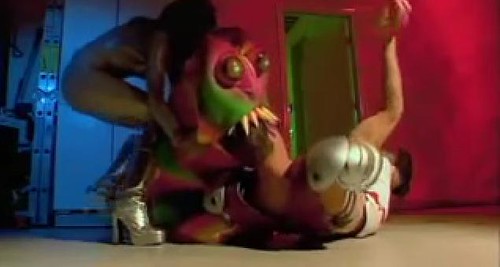
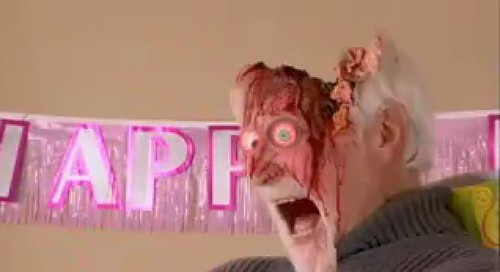
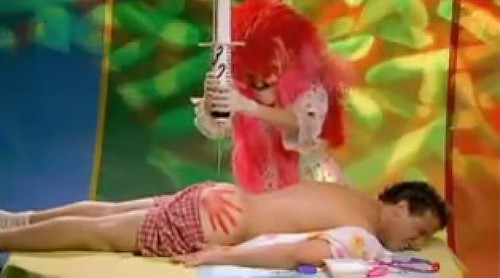
Author: Jared RobertsIt's about as hard to review Terror Toons 2 as it would be to review a Melies film, which Terror Toons reminded me of, in fact. Is it a good film? Well, not by the conventions of a good film. Is it a bad film? Not really, because it's entertaining and original, even if highly processed through Adobe Premiere and/or After Effects. It's a film strung together of setpieces, setpieces that are best described as a fusion of Tom & Jerry with H.G. Lewis. Terror Toons is essentially an inventively violent cartoon show taking place with real flesh and blood people.
http://farm3.static.flickr.com/2747/4132803365_013370809b.jpg - That cat will soon be Adobe Premiered right out of frame.
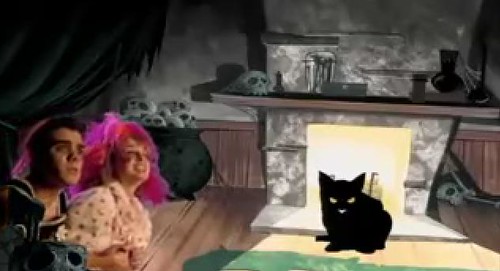
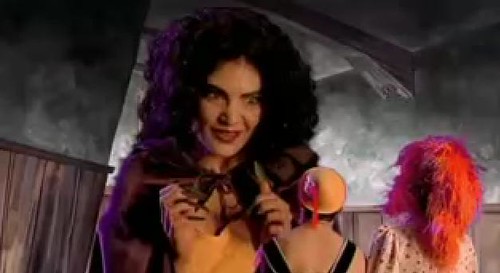
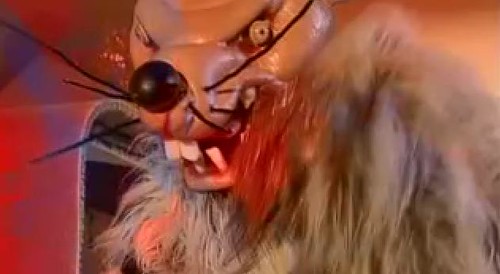
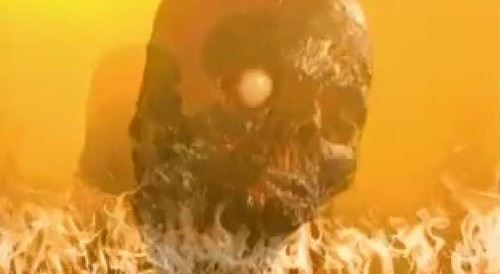
The plot is pretty simple. Hansel and Gretel have been turned into a giant rat and a bug-eyed bitch. A DVD made by the devil (anyone can get into distribution these days) allows these jackass toons to escape into the real world at a birthday party, where they wreak havoc. What follows is several violent and often gory setpieces. Eventually some of the party guests leap into the cartoon world to try figure out how to stop the madness. More violent, gory setpieces ensue. They venture into hell. Gain superpowers. Then come back to do battle with a rainbowslug thingy.
http://farm3.static.flickr.com/2803/4132803387_fabe399395.jpg - Brinke is gonna teach Hansel und Gretel a lesson.
http://farm3.static.flickr.com/2596/4133563232_7050aceff2.jpg - Hansel is a rat pfink.
http://farm3.static.flickr.com/2569/4132803269_1d6d3b42dc.jpg
The setpieces are, I think, quite impressive. They're not as inventive as Tex Avery or Chuck Jones--is that even possible?--but they're as inventive as a good many of the violent cartoon shows we grew up enjoying. Brains are removed, monkey brains are installed; people are flattened, ripped apart, exploded, and often vomiting. It's a wet and wild film, to say the least.
http://farm3.static.flickr.com/2702/4132803297_5a1a872fed.jpg - "What has Adobe done to meeeee?!"
What I really didn't like were the bursts of reality that interrupt the setpieces. They take the time for a harrowing, sad moment after daddy is killed by a toon. Why do that? Joe Castro is a sadistic man! Also, there's way too much pleading by these annoying characters. Everybody asks the toons at least once, "Why are you doing this?!" and says "This is sick! Sick!" Just shut up and let the toons kill you already!
http://farm3.static.flickr.com/2780/4133563166_f5e811c011.jpg - Welcome to chroma key hell!
I was surprised, too, to discover that Joe Castro is a married man, because unlike most horror films, we don't get any babes. The women are pretty plain and stay clothed. No, we get studs--handsome young men, or boys, rather, seeing as they're pretty young: muscular, callow youths, who are only too eager to take off their shirts and shorts.
http://farm3.static.flickr.com/2690/4133563116_db630bd855.jpg
http://farm3.static.flickr.com/2491/4133563146_2417dba6fa.jpg
http://farm3.static.flickr.com/2628/4132803439_610555c4c9.jpg - No dignity allowed on the set of Terror Toons.
So that's Terror Toons 2. I haven't seen the first part and I won't be going out of my way to watch it. It was a mildly entertaining film, I liked the highly-processed style and the setpieces; but it's still dopey and uneven, with no sense of pacing or narrative at all. But if you want to let your inner child play fetch with your inner gorehound, Terror Toons is one of the few ways you can do it.
Bonus points:
Creepiest clown birthday song ever
Clown-killing action
Animated GIF animals
Categories: 2007, horror, slasher Thursday, November 26, 2009 | at 12:20 PM 0 comments