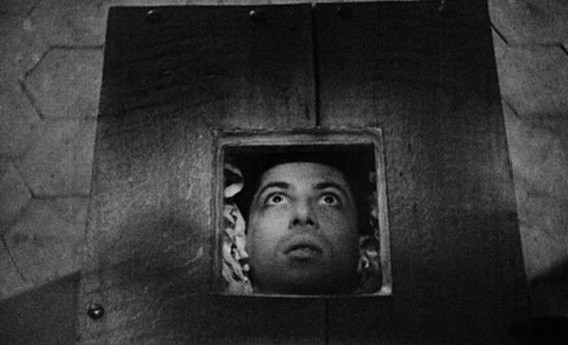
Would you watch a horror movie just for one great shot? I did. Because Svengali, while not a bad film by any stretch, offers one awesome shot at its centerpiece that really makes it worthwhile. Want to know what that shot is? Keep reading.
Svengali is based on George de Maurier's Trilby, the somewhat antisemitic story of an artist's model named Trilby, who falls under the spell of amoral Jewish hypnotist Svengali. Svengali himself is a stereotype, not unlike Shylock. He has the long nose, dark eyes, beard, and a generally avaricious nature. The great John Barrymore himself portrays Svengali in the film. You'd think that would ensure great depth in the character, but no, the character remains a little flat, though still fascinating.
This fascination with Svengali is what the film is shooting for, because the film's title is not Trilby, but Svengali, the supposed villain. It'd be like if Dark Knight were called Joker--it changes everything. Dracula was always called Dracula, but this required a creative choice. One would expect this change in title would result in a more sympathetic approach to Svengali, but not so. He is a repugnant character. Initially he's played for laughs and I actually found him kind of funny; I would have been willing to sympathize. But it quickly turns sinister. Kind of like Dickens' Uriah Heep, everything Svengali does or says is self-serving. He has British 'friends,' but it's clear he only visits them to mooch. He teaches piano, but clearly just to seduce women. He seduces women just to make money off them. There is no better side of him to appeal to; being nice to him doesn't help. He can seem very kind, but he really cares not the slightest for anyone else's well-being. And he's ever playing the victim. The final moment of the film is a grim apotheosis of this personality. Having acquired nearly everything he ever wanted, he calls out to God to grant him in heaven what was deprived of him in life and smiles, seemingly assured he'll get it.
The film's plot plays out just as in the novel. Svengali discovers his eyes have hypnotic power. He himself seems convinced it's supernatural. He crosses paths with the beautiful Trilby. He's interested in her for the money he can make off her voice, although he's also keen on making her Mrs. Svengali. Once he's hypnotized her, we get the shot: Beginning with a close-up of Svengali's glowing eyes, we pan out of his apartment window out of which he's staring and hover above the city; then the camrea turns around and flies over the city to Trilby's apartment where she suddenly awakes from sleeping. I believe this was supposed to be one shot, but the trick edits were anything but smooth; it's actually about three shots. From there on, Trilby fakes her death and her artist friends eventually discover she's become Mrs. Svengali. They try to rescue her. Can they break the spell?
The art direction and cinematography each got an academy award nomination and are definitely the film's greatest achievements. The idea of a pan across the city is used in another evil hypnotist film just a year later: The Mummy. The sets are all slightly toned-down expressionism and have the feel of a Universal picture. Unfortunately the story is paced somewhat poorly and the characters don't have much time to develop, not even Svengali or Trilby. None of them are terribly likable, either. So is it worth tracking down? Not really. But if you catch it on Turner Classic Movies, watch to the middle to see that shot.
Help make this site more interesting through discussion:
Svengali (1931)
Author: Jared RobertsWerewolf of London (1935)
Author: Jared RobertsTurn-of-the-century London was deemed the cradle of civilization, the place of Society--that anomalous animal that Oscar Wilde castrated with his pen. The wealthy, noble, or otherwise important who had charm were taken into London society, usually by busybody hostesses with no greater use for their scant brains and plentiful money; to no longer be invited to parties, to be excommunicated from London society, was as frightening as death to some. Perhaps when one's personality has been substituted by social banter to lose society is death.
So much for London. Now about the werewolf. That is Dr. Glendon, a very serious biologist with a too-severe work ethic. He journeyed to Tibet and acquired two things: a rare flower never before studied under lab conditions and the bite of a werewolf. He has filled his life with his obsession with flowers, not the least of which is his much younger wife. She is indeed a flower, pretty with gowns always reminiscent of floral petals and hats of the floral center. She is being neglected for the new flower, about which Glendon is eager to study and publish his findings lest anyone get in before him. The more obsessivedly he studies his plant, the further he withdraws from society; the further he withdraws from society, the more he seems to become a monster, an outsider, the other. And once the full moon rises, his monstrous quality becomes literal.
Glendon's major flaw is not his distance from London society, but his distance from society in general. He obsesses over his work and never talks to anyone. He makes clear that he's frightened his data will be stolen from him; perhaps he keeps silent entirely out of scientific ambition. Yet, if he would confide in his wife or his professional friends, he may have been helped before the lycanthropy overpowered him. He confides in no-one. The less he confides, the more distant people become; the more distant they become, the more irascible he becomes and the more distance still is put between he and his social circle. This is especially the case with his wife. Every other character in the film is social; they all have someone to talk to or confide in. Even the drunken old ladies who appear for comic relief, however neglected and abandoned, have each other. Other people keep us human. But Glendon walks alone. He is, yes, a lone wolf.
London society takes the form of a circle of social elites generally organized around a busybody socialite named Ettie Coombes with more gusto and money than brains. She's responsible for the forward motion, the pace, the smooth linking of much of the film and its characters; without her the film would be very plodding indeed. Ettie, as the symbol of London society, is about the polar opposite of Glendon. She wants to be surrounded with interesting people constantly; she has no thoughts of her own, but delights in everyone else's. Not surprisingly, Ettie is the first person to see Glendon as a wolfman. As Dr. Glendon withdraws from society, she begins hooking Mrs. Glendon, Lisa, up with Paul Ames, a childhood sweetheart and much more social person. Paul becomes the pseudo-hero, hunting the wolfman and trying to steal Dr. Glendon's wife, without ever realizing both actions are bound up together. He is the cause of Glendon's further distancing from his wife.
One imagines Dr. Glendon must have been enjoyable to be around at some point. His wife is not really a trophy wife. She's younger, but she isn't stupid. She really loves her husband. She is, however, rather juvenile. The film takes place largely over a four day period. One would think her husband had been neglecting her for months by the way she reacts, but he's only just begun studying this plant. When he asks her to be patient, it's hardly a major request, even if he did just return from a probably lengthy voyage to Tibet. Ettie's orchestrations and the presence of Paul are largely responsible for Lisa's increasing discontent with Glendon. Were she more patient and understanding, Glendon may have confided in her. His jealousy over Paul and her need to constantly be in society makes him more distant.
Such is the tragedy of Werewolf of London. It is a tale of two monsters, the werewolf and London society. My sympathies lie squarely with the tragic monster of the werewolf, a sensitive man who loves flowers, science, and his wife. I have said nothing of the real villain of the film, Dr. Yogami, the original werewolf who is also after the plant for its medicinal properties as the sole antidote to lycanthropy and steals the plant from Glendon. He curiously gets sucked into London society and is much more clever at playing social. He is never suspected. He is more peripheral and a bit of a contrast to Glendon, but essentially in the same situation: a werewolf desperate for a cure.
As is generally the case with Universal horror films, Werewolf of London is a character-based story. It has the sensitivity to individual personality of a play; not coincidentally, Universal scripts were generally based upon plays or written by playwrights. The horror of a monster invades seamlessly the character dramas. The fascinating characters of this story, particularly the upbeat Ettie and the decidedly lowbeat Glendon, creates a strong and deep horror film that really holds up. Holds up? Forgive me, I mean to say, "They don't make 'em like this anymore."
9/10
Incidentally, Werewolf of London was the first major Hollywood werewolf picture.
Categories: 1930s, horror, werewolf at 12:55 AM 0 comments
The Son of Frankenstein (1939)
Author: Jared RobertsNo such thing as diminishing returns in Universal's Frankenstein series, it seems. Son is not the zany phantasmagoria Bride is, nor is it the somber character study the original is, but it has a mixture of both and one hell of a lot of spunk. The credit for this goes to whoever wrote these odd characters--truly some of the oddest people I've ever seen interacting this side of a David Lynch film--and the fantastic performances given by svelt young Basil Rathbone, Boris Karloff, an absolutely demented Bela Lugosi, and Lionel Atwill.
To write a glowing review of Son of Frankenstein for horror fans, I could have simply listed those four names and clicked 'Post'--mission accomplished. But movies like this really grab my interest. It reminds me very much of Tod Browning's The Devil-Doll, not in the plot points, but in the manic energy. It's as if Rathbone, Atwill, and Lugosi all decided to try and upstage one another. It's pretty hard to upstage a monster, but actually Karloff's monster is the most lowkey of the four. Bela Lugosi steals scenes from a monster. And Lionel Atwill almost steals the movie, were it not for the most nervy performance I've ever scene oozing from Rathbone.
The plot concerns the new Baron Frankenstein, son of the monster-maker, who also happens to be a scientist. He initially strikes one as a jovial fellow, but as the film progresses and his 'bundle-of-nerves' quality soars to heights possibly unparallel, I really had to wonder what this guy is really like. He seems to have the best of intentions; but it doesn't take much coaxing to have him raising a monster from the dead and killing a man. I think, actually, they were going for a return of the original Frankenstein theme: hubris. He frequently says things like, "Nothing in nature you understand needs be feared," and "I am afraid of nothing." He's a decent man with cosmic aspirations that end up putting his son in jeopardy (or do they?).
The townspeople have it in for Baron Frankenstein from the moment he arrives. He tries to greet them warmly, but they'll have none of it. There are some great moments showing the council of village elders discussing the vileness of 'the Frankenstein name.' This enough to unnerve anyone. And a major part of Frankenstein's motivations in this film are to vindicate both his family name and his father.
Enter Bela Lugosi as Ygor, about the polar opposite of the charming Dracula. Ygor is unkempt, vile, hateful, and played to the hilt by Lugosi; I hardly recognized him. He's been hiding the monster, using it to kill, and since it was struck by lightning, sheltering the comatose body. Somehow he's earned the monster's adoration, even though his concern for it doesn't strike me as anything but selfish and proprietal. He is a nasty, murderous creature who managed to survive a hanging. But since he was pronounced dead by the local physician--who is never wrong--he can't be hanged to death again. This leaves him with a distinctive broken neck. Ygor gets most of the film's best lines: a series of dark one-liners involving his own hanging, his neck ("Got a bone stuck in my throat"), and his murders. His presence puts the Frankenstein name at risk, because he is using the monster for evil.
Lionel Atwill's Inspector Krogh is the zany center of the film, kind of like Dr. Pretorius was in Bride. Polite, stiff, gentlemanly, and sharp, the Inspector's kindness and concern for the Baron quickly make him a thorn in his side. He has a wooden arm and a monocle. The original arm was lost to the monster: "One does not easily forget, Herr Baron, an arm torn out by the roots." In various scenes he uses the wooden arm to do things, like hold his monocle, while he wipes it, but neither he nor anyone else every mention it; it's just something he does. There is an incredible moment when the Inspector and the Baron are having a sort of passive aggressive showdown, talking to one another politely and angrily at the same time; it's so very odd, but it somehow encapsulates the film's essence: seemingly gentle and zany, yet it packs quite a whollop and is actually pretty macabre.
The last of the key players is Karloff's monster. Certainly the moral center of the film. He's killing because Ygor tells him to, but when he finally is overcome with wrath, it's not clear what his intentions are. Thinking on his own, does he make a moral decision? You can see the enormous influence on George Romero in this film. There's a moment when it looks like the monster is going to kill someone, but he doesn't; it's not clear if he ever intended to kill or if he changed his mind right there. I think it's the latter; the monster learns to make moral choices. The monster is still a child, really, but Rathbone can't bring himself to see it as anything other than an experiment; that's part of the tragedy here.
Son of Frankenstein is probably not for everyone. It's a love-it or hate-it sort of movie, I'd imagine, because it's so crazy. The film is filled with images of crumbling and decay: missing arms, broken necks, half-destroyed buildings, as if he natural progression of Frankenstein's experiments have tainted the environment around him. To my mind, this makes it the perfect third entry in the Frankenstein series. I love this movie and it's odd characters, Inspector Krogh most of all. It's not the equal to Bride or the original, but I think I might have enjoyed watching it even more than I did those.
Categories: 1930s, horror, monster at 12:53 AM 0 comments
Dracula's Daughter (1936)
Author: Jared RobertsFor this review, I'm simply going to describe the characters.
- The countess is a complicated character. She initially seems sympathetic, with a strong desire to be a normal woman again. As she goes about trying to become human, she is selfish and petulant, putting the lives of others at risk and become annoyed when her will is not obeyed. She is a manipulator. Yet, she genuinely does want to stop killing others and to be normal; her urgency is in earnest.
- Sandor is a foil to the Countess. While she wants to be a human, he wants to be immortal. It's kind of amusing how he foreshadows the goth subculture of hte '80s, with his greased-black hair, dark lipstick, thick eyeliner, all black clothing, and general talk about 'death' and 'darkness'. The actor is actually a rather handsome fellow, but he's damn creepy as Sandor, particularly when he's introduced at the burning of Dracula's body on this lovely, foggy, chiarascuro studio set. His hopes and dreams are dependent on the Countess not achieving hers, which is a source of much dramatic tension. If she becomes human, he can never be immortal. But since she despises being a vampire, she certainly has no interest in bestowing it on others. He never acts against the countess until the end, but is always pleased when she fails at her goals to be human and tries to discourage her.
- Dracula is an invisible character in the film. The Countess blames all of her troubles on Dracula. She describes it as a voice with such power that it overcomes the grave to call out to her, commanding her to do what she does. Kind of the way Imhotep controls Zita Johanne in The Mummy. The gives way to some discussion about the power of the will. She thought burning Dracula's corpse would free her, but Dracula's spirit lingers, so she seeks to aid of science, hoping it's some sort of hypnotic spell that can be cured.
- Dr. Garth is the doctor to whom the Countess turns for help, and also a friend of Dr. Van Helsing's. Initially her interest in him is as a man of science who can be of service, but soon she's overcome with lust and wants to make him immortal. Her desires are what drive her back to the dark side; she ceases to care about being human. The dark side of love, I suppose? Or childish desire? It seems more juvenile than romantic. At any rate, Dr. Garth is an unusual character for the lead. He is plainly a grumpy man, if very professional. I mean, he makes Harrison Ford's characters seem downright cheerful. He likes things to go very smoothly and is annoyed at the slightest wrinkle in his plans. Like most men of this sort, he is stubborn, won't back down, and a bit volcanic with his temper. Anyway, he has two women in his life now: the Countess and his immature secretary, Esme, who is the daughter of a Baron. While he's lured to the countess for her exoticism, need for him (he likes to feel strong and needed--which is why he resents Esme so much), and apparent maturity, his sparring with Esme is clearly loaded with sexual tension and he cares about her. He's also very dependent on her for just about everything, much to his chagrin. He's a bit of a wanker if you ask me.
- Esme is the well-educated daughter of a Baron who, while unable to get a professional job of her own at the time, is employed as secretary to the doctor. Most of her time is spent locking antlers with him, as she tries to show she's independent and strong and to get his attention. Sadly, he doesn't respect her very much and seems to wish she'd be more dependent on him. The irony is that he can't tie his own tie without her. She's clearly jealous of the Countess' presence in the doctor's life and tries her bestest to get rid of her, until the Countess kidnaps her, forcing the doctor to choose. Funny thing is, the doctor doesn't get to choose. Sandor does that for him. She's pretty much the polar opposite of Sandor, urging the doctor, in her misguided way, towards good.
- Van Helsing, played by the great Edward Van Sloan again, is being tried for the murder of Dracula and Renfield, so he's of very little help in the film. It is more or less structured so that the events involving the Countess serve to exonerate Van Helsing of the murder charge. He's not directly involved in the proceedings.
So there you have it. Dracula's Daughter is very much a character-based story. If you get the psychology of, parallels and relationships between these characters, you see you have a pretty strong and fascinating film on your hands.
Categories: 1930s, horror, vampires Sunday, October 18, 2009 | at 9:09 PM 0 comments
Two Animated Shorts
Author: Jared RobertsREVIEWS:
Who Killed Who? (1943)
With more visual inventiveness in under eight minutes than any David Lynch or Lucio Fulci picture has in an hour, all of Tex Avery's shorts are fantastic.
While ostensibly a murder mystery, Who Killed Who? plays as an old dark house picture. We begin with a long, slow pan into a window above the mansion's front door, all the while archetypal horror sound effects are played non-stop--gee, what's going on in there? Nothing. But it's spooky, isn't it?
As the detective arrives to solve the murder of the man we first find sitting a chair labeled 'Victim,' skeletons, ghosts, suspicious servants, and a hooded murderer pop out of the woodwork.
Oh yeah, and it's even got some cheesecake for the guys. Great fun. Check it out here: http://www.youtube.com/watch?v=U89qW4-ht7w
Bold King Cole (1936)
Felix the Cat is too darned happy, so nature conspires to throw a thunderstorm at him in the midst of his banjo solo. Well, the only refuge for poor Felix is an old castle across the gorge, where dwelleth King Cole.
King Cole is a pear-shaped coward, but he boasts a lot. Enter Felix. Cole begins boasting to Felix in the hall of paintings, where the ghosts of previous kings--all with working-class Bostonian accents, oddly enough--conspire to teach the old windbag a lesson. And holy **** do they ever!
This little short actually traumatized its fair share of children when originally shown, or when placed on budget VHS cartoon compilations.
Now it's disturbing a brand new audience on Youtube:
http://www.youtube.com/watch?v=isbzfRh4za8
Check it out, enjoy the terrific score, and the general playfulness with image and sound--especially sound.
FACTS:
Who Killed Who?
Director - Tex Avery
Voices - Tex Avery, Billy Bletcher
1943
8 min
Bold King Cole
Director - Burt Gillett
Voices - ?
1936
8 min
WHERE TO GET THEM:
On Youtube.
Who Killed Who? is also a special feature on the DVD for Presenting Lily Mars.
TIDBITS:
In Hellraiser: Deader, a character is seen watching Bold King Cole.
Who Killed Who? is featured in Twelve Monkeys.
The Devil-Doll (1936)
Author: Jared RobertsREVIEW
Every now and then, maybe once a decade, a film comes along that is so inspired in its goofiness, so courageous in its preposterousness, so earnest in its madness, that it navigates past seemingly impossible obstacles to a sort of perfection. The Devil-Doll is one of those rarities.
Directed by none other than Tod Browning, we are given a tale that involves a mad scientist with frightening ambitions, a jail-break, a truly touching father-daughter reconciliation, a crime-committing shrunken woman, a conspiracy by a triad of bankers, a revenge plot, a dashing taxi-driver, the Eiffel tower, and Lionel Barrymore in drag.
I try to keep these reviews serious, but The Devil-Doll defies me. I shall try my best. We begin with Lionel Barrymore--who is fantastic in this film--breaking out of jail. He stumbles into a cabin that just happens to be filled with mad scientists. Fortunately for Barrymore, he hits it off with the scientists and they soon want to enlist his aid in their diabolical plans to shrink the world!
In fact, the plan is not diabolical at all. The scientist wishes to solve the problem of world hunger. So, if he shrinks everything in the world, there'll be plenty... no, wait, that doesn't work. Barrymore knows it doesn't work. The scientist, however, is really a madman. In this film anything can happen, and it does: the scientist suddenly has a stroke and dies. Barrymore is thus left with the marvelous new technology and the scientist's even madder scientist of a wife.
Barrymore now has everything he needs to exact revenge on those who had him wrongfully placed in prison: a shrink ray, a mad scientist, and drag. He sets up shop as an old granny toymaker and sets about his revenge while he tries to strike up a friendship with the daughter he never got to see grow up.
That covers the first fifteen minutes. The film is densely-plotted. The writers squeezed everything they could into this already-wild story, and Browning somehow pulls it off. It is a great film, the equal of anything Browning's ever done.
The relationship Barrymore has with his daughter is genuinely affecting. The love he feels for her, the anguish he feels in a situation that prevents him from reaching out to her, and her bitterness over never knowing her father are all deeply felt.
The revenge plot brings various moral questions to the fore. How can a man who loves his daughter be using a shrunken woman--the titular devil-doll--to commit horrible crimes, when he knows it will prevent him from seeing her? Does he really plan to give the mad scientist what she wants in exchange for her help?
With some neat special effects obviously inspired by Raoul Walsh's The Thief of Baghdad, some excellent writing, outstanding acting, and Browning's masterful direction, this goofy film is guaranteed to entertain and move.
FACTS
Director - Tod Browning
Writers - Garrett Fort, Guy Endore
Starring - Lionel Barrymore, Maureen O'Sullivan
1936
78min
WHERE TO GET IT
This film is not so rare or unknown as the others in this series. It is available on MGM's Hollywood Legends of Horror Collection.
TIDBITS
Guy Maddin highly praises this film. He even selected it for screening at the Toronto International Film Festival.
Screenwriter Guy Endore also wrote the novel that was adapted into Hammer's The Curse of the Werewolf.
Categories: 1930s, cultclassic, horror, scifi Tuesday, December 16, 2008 | at 9:38 PM 0 comments