The Texas Chainsaw Massacre is one helluva movie. Like the Hamlet of horror movies, if a movie goes anywhere near its subject matter, it does seem to be imitating it. Imitating The Texas Chainsaw Massacre isn't such a bad thing; just that its tones are so delicately balanced and ambiguous it'll be very easy to mess up. There's something darkly comedic about TCM, and yet it's never stupid or goofy. It's vicious and violent, yet strangely reticent to show you its ugliness. It's meaningful and satirical, a caricature and a portrait, but never self-consciously so, never blaring a message.
I could go on, but why bother? TCM is alive and making money still. Skinned Deep is an obscure and undeservedly neglected slasher in the TCM vein. Other films that tread the TCM territory, like Kevin Connor's Motel Hell and Hooper's own TCM2 both tried to play up the comedy and over-the-top feeling of TCM. Both films are excellent in their own right, if not as perfect as their template. Skinned Deep goes a country mile farther. This move is probably for the worse, but it sure results in a unique film.
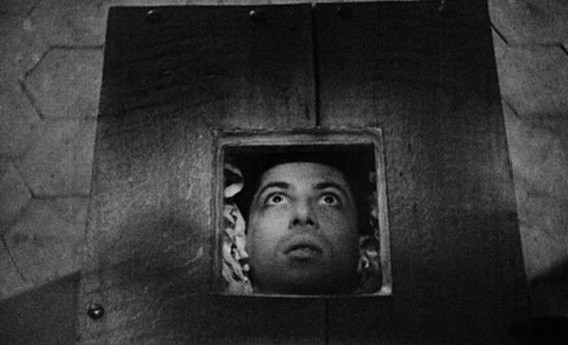
Skinned Deep, much like TCM, concerns an odd 'family' that dwell together in a fiendishly eccentric house that is a small triumph of set design. This family similarly preys on stupid, American passers-by who happen into its traps. In this case, the Americans are ten times stupider, a family of fat fools who all but place their heads on the chopping block. This leaves the barely attractive teenaged daughter in the position of taking on the whole family herself. Fortunately she's under the protection of 'Brain' AKA 'Brian,' the family's childish but well-meaning sweetheart, with an enormous, skull-less brain and a single set of overalls.
The girl is dragged through one horrible situation after another as the family tries desperately--due to Brain's pleadings--to socialize her into the family. This involves some bizarre hijinks like a battle with a gang of decrepit bikers and the random murder of some joyriding rednecks. The film culminates in meeting 'The Creator,' a headless 1960s Sean Connery, flexing compulsively and speaking in riddles out of the ether.
I don't think there's any sense to Skinned Deep's absurdism. It's crazy for the sake of it. If you can't enjoy Warwick Davis as a plate-throwing midget that spews philosophy and does jinjitsu dances after every murder, a headless Sean Connery, a metal-jawed slasher called 'The Surgeon General,' and intentionally terrible dubbing, you've already missed the boat. It's strange and silly and you're supposed to like it for what it is.
As it happens, I liked it very much. But it's nevertheless a deeply flawed film. There is no seamless blending of tones like in TCM or even Motel Hell. The Surgeon General is a pure horror movie creature and as cool-looking as any slasher villain ever created, maybe cooler. The scenes involving him are often moments of pure horror, intended, it seems, with some seriousness. Then we see Brain prancing naked through crowded streets. There's no consistency, no clean segueing from tone to tone, just abrupt shifts from episode to episode or sometimes mid-episode.
All of this is lovingly filmed in a muddy 16mm that reminds of a good ol' HG Lewis movie. And the comedy in this movie probably comes closer to Lewis's sense of humor, incidentally. Skinned Deep has more in common with the insanity of The Gore Gore Girls and The Gruesome Twosome than Hooper's or Connor's subtlety. The shooting, however, is much better than anything Lewis ever did. There is a real sense for the tones of 16mm, particularly in the night shots, and an often brilliant use of abstraction rarely seen outside of Hitchcock.
Writer-director Gabriel Bartalos's next creation is Saint Bernard, another surreal, horror epic set for release sometime in 2014. I'm very eager.
Skinned Deep (2004) - 2.5/4
Disconnected (1983) - 2.5/4
Phones are creepy. The proliferation of cellular phones today has transformed them into almost an extension of the body. I'm old enough to remember a world without cell phones. I'm old enough to remember rotary phones--and I ain't even that old, I'm just from a small town. In those days, the phone is this mysterious chunk of plastic you keep in your home where disembodied voices can access you at almost any time. Sure, it's usually your grandma asking if you remember where she put her purse. But sometimes that call at 3am could be someone you don't know, and you're permitting that stranger's voice to be in your home, to have access to your ear. Phones are creepy.
Disconnected is a movie that wouldn't work so well in the era of cellular phones. Something about those analog lines was different, both more personal and yet more otherworldly. Especially when we had no caller ID and couldn't google the number. The protagonist, Alicia, has a white rotary phone--a Model 500, I suppose--that starts ringing in with strange calls. As she recriminates her boyfriend for possibly screwing her twin sister, she hears her boyfriend talking to her sister over the phone. Thing is, neither her sister nor her boyfriend live with her and it's no party line.
Meanwhile, a serial killer has been murdering women and the police are desperate to find him. Just happens Alicia's rebound guy is none other than the slasher himself, a soft-spoken film buff who hits on her in the video store. These murders are remarkably bland affairs in which the effete film buff repeatedly sticks his embarrassingly small blade into dispassionate sluts. Including, eventually, Alicia's slutty twin herself, Barbara Ann.
What really makes Disconnected stand out is not Joe, the rude video store customer who leers at Alicia while asking about the latest porn releases. It's the weird phone calls. As the film's title indicates, the calls are 'disconnected' from the rest of the plot. Sort of.
The killer is shot by police halfway through the movie, leaving Alicia in a confused state she can only alleviate with chain smoking and binge drinking. We watch her 'downward spiral,' I guess, in a variety of indulgent montages that say, "Hey, I may have gone to film school." And I'd believe it. Gorman Bechard's direction is pretty assured for a debut slasher. Still, usually once the monster is dead, the movie ends.
That's the trick. The serial killer isn't really the monster. Alicia's mental state aside, she does continue to receive bizarre phone calls in which an alien voice growls gibberish at her. We also learn in passing that the serial murders are continuing, and all victims received harassing phone calls before they got it. Aha!
But then, just when you're intrigued about what's really going on, that's when Bechard decides to end the movie. And he ends it on a high note: with an old man leaving Alicia's apartment and walking away with his hands behind his back. Dun nun nuuun! That's actually the way the movie started. The old man asks to use her phone and is never seen again. What could it all mean? Only two people know: Gorman Bechard and Joe the porn afficianado--that's just my theory.
Disconnected is certainly one of the more peculiar slashers ever made. It's interesting, tries to be ambitious and subtle, fails miserably in the blood and tits departments, but succeeds in totally confusing everyone. That's a C+ in my book.
Pledge Night (1990) - 2/4
The slasher genre has a strange fixation on fraternities and sororities. I'm not sure why that is. They are a standard location to find a bunch of young adults and kill them. So there's that. Also, many slasher directors were using the AV room equipment at their college in between liberal arts courses. On the other hand, most of these slashers were made in the '80s. The '80s itself was kinda obsessed with the idea--whether being treated seriously or subverted--of fraternities and sororities as the building blocks of social success. In some way, these slashers were undermining the value of fraternities and sororities, presenting them as an extention of the poisonous teat upon which socially successful children must suck until they become full-blow sheep themselves. Rich, powerful sheep. Or maybe it's just because lots of douchebags, tits, and sex is likely to be there.
Pledge Night is even more fixated on the operations of the fraternity life than most slashers of the kind. The first half (yes, half) of the film follows the pledges through the process of initiation into Phi Upsilon Nu (That spells PhUN!). The way the 'officers' play with the pledges is scrutinized and the values they attempt to instill is presented clearly. The fraternity is all about loyalty and brotherhood. And the best way to make loyal brothers out of young men is to make them carry cherries with their perspiration-drenched buttocks for hours and then eat them. Straight out of Plato's Republic.
One pledge is a particular focus, as his mother is an old hippie who distrusts frats. Maybe she distrusts them less out of social protest and more out of, well, her ex-boyfriend was killed in a bad hazing incident in that very house. He was a well-meaning hippie named Joey Belladonna. I mean, Sid. Never saw it coming. But the pledge also got in with one of the officer's girls enough to know that the supposedly crazy frat member is all an act. Or is it?
Finally, just when you're starting to feel like you're being hazed by this movie, the frat exposition reaches climax during an exhausting monologue about the ancient history of PhUN. These frat guys really take themselves too seriously. Fortunately, the fake maniac becomes a real maniac and begins killing his 'brothers' while cackling with haemorrhoidal glee. But he's not just gone psychotic. He's been possessed by that hippie ghost, Acid Sid. Sid no longer believes in free love. He believes in asking people who they are, then killing them in gruesome ways. After crawling out of the frat brother's caved-in body, he strangles a pledge's with his own spinal column, melts another pledge's head in his vaginal gutwound, and chases the final guy and gal around the confusing frat house. They meanwhile hide in a secret room behind an American flag.
Yes, Pledge Night is a movie all about freedom and what America is really built on: rich, powerful families and the connections made in fraternities? or the human spirit that will never be satisfied as long as someone's oppressed? Neither. It's based on heavy metal, cheesy movies, and tittays. As Joey Belladonna sings in his epic ballad Efilnikcufecin, "Just one too many cookies/From the batch no one should taste." Or in Caught in a Mosh, "Your mother made a monster, now get the hell out of my house." Words to live by.
Maniac (2012) - 3.5/4
Maniac is a remake of the 1980 William Lustig classic slasher of the same title. Lustig didn't just approve, he also produced this remake, helmed by P2 director Frank Khalfoun. What makes Maniac really stand out, however, is the casting of Elijah Wood as the titular maniac, replacing the overweight and middle-aged Joe Spinell of the original. While the plot remains very similar, the new casting recasts (pardon the pun) the entire meaning of the film with impressive results.
Wood plays 'Frank,' a mannequin collector/restorer in New York. He was raised by his single mother, who whored around for cash and/or pleasure, often bringing men home where little Frank saw way too much. Frank now has a very ambivalent relationship to sexuality. Specifically, he likes to scalp women and place their hair on mannequins instead of screw them. One day the photographer Anna takes an interest in his mannequins and seems to offer womanhood some redemption at the same time.
A film like Maniac will never come anywhere near the Oscars or any other glitzy award ceremony. Yet, Elijah Wood's performance is as deserving of those awards as any other modern performance. Even as hampered as Wood is by the mostly-POV photography, where we share Frank's eyes, he still allows us to share Frank's anxieties, joys, and anguish through his voice and the few mirror shots Khalfoun provides. Wood proves, again, that he is the most versatile actor around, and easily one of the most talented we have.
The decision to force the film's viewpoint to be almost entirely Frank's was certainly a risky one. The intention, of course, is to make the audience sympathize and even empathize with a sadistic serial killer. Initially, however, the effect is alienating and uncomfortable. As the film's tensions increase and it hurtles toward an emotional climax, the discomfort is long forgotten. Wood's performance and Khalfoun's deft direction make it work. I'm still not sure it was necessary; but it works. By Maniac's end, I was entirely on Frank's side. I hoped not for the survival of a 'Final Girl,' but for her brutal slaughter. That became the happy ending: the serial killer protecting his heart from the awful people in the world. What kind of relationship between art and morality does this illustrate? I don't know. But Michael Haneke wishes he'd made Funny Games this well.
That is not to suggest the the film's psychology is insightful. Coming from the pen of Alexandre Aja, rewriting for Joe Spinell, there is little psychological realism present. Horror film psychology has always been a little glib, from the weird videos in Peeping Tom and the instant diagnosis at the end of Psycho on. Maniac pushes this to a point at which it has gone beyond even touching reality. The psychology of Maniac is fantasy psychology, where blood-spattered mannequins wearing fly-covered scalps can be models of purity for a psychosexually tortured psyche. I empathized with Frank and even rooted for him because, despite the near camp moments of fantasy psychology or maybe even because of them, there is a strongly pronounced emotional reality to the disturbed Frank, a wounded core that does not seem beyond redemption.
The bottom line is, Maniac makes very few missteps of any kind. It is a traditional slasher film made in 2012 that exceeds nearly any of the modern, ultra-violent slasher films made in the last decade-and-a-half. It also happens to be one of the finest horror film remakes I've ever seen. Khalfoun went way beyond what he'd done with the average P2, and Aja as screenwriter reiterates his ability to remake his favorite horror films. Bravo to all the talent involved.
Rites of Spring (2011) - 2.5/4
Since time immemorial, plucky blondes have been known to be disasterous for harvests. That's why they had to be sacrificed to crop gods all the world over. Or at least given entry-level secretarial positions. Jump forward hundreds of years, and we have all but forgotten the wisdom of our forefathers. Now plucky blondes appear in board rooms, vote in senates, and even write movie reviews.
The Rites of Spring begins with a failed harvest of sorts. A blonde (Anessa Ramsey) has cost the corporation that employs her $10 million. The boss has no idea who was responsible for the blunder, so he's fired some others whom he either appreciates less or wants to fuck less. Before she can confess her mistake to save her colleagues, she's kidnapped and taken to a barn, where an old man tortures her and her friend. Meanwhile, the stooges who got fired plan a heist to kidnap the boss's daughter and get $2 million in ransom. Their desperate plan takes them somewhere in the woods not far from where the blonde kidnapper has taken her. She escapes and finds her colleagues, but something much worse than the old guy is following her.
Rites of Spring begins with that intricate bit of plotting, which serves the dual purpose of giving us a lot of assholes we want murdered and not boring us during the exposition phase. Maybe there's a comment in there on the persistance of old-time harvest values in modern society or karma and consequences or something. I don't know. What it does is launch us into the real meat of the movie, which is somewhere between a slasher and a creature feature.
Here Rites of Spring is only moderately successful. The blonde is just plucky enough for you to care about her survival and the creature is just dangerous enough to make you fear for her safety. The basic mechanics work. However, giving the creature a blade to kill with really takes away from his creature-ness. And his creature powers make him such a formidable slasher, that it's hard to buy the blonde has enough pluck to get away--we're talking astronomical levels of pluck.
The creature's purpose and significance, and its relationship to the old man are all sources of intrigue that drew me into the film. Perhaps these were the most interesting aspects of the film, in fact. Far more interesting than who was double-crossing whom in the heist subplot. Yet, in the abrupt ending, I realized I knew more about the heist than the creature and old man. All we do know is it has something to do with the harvest. Is the creature the shambling personification of winter, the death that must come before the harvest? Or is it just a zombie with a scythe? Or is it a real harvest deity that needs plucky blonde blood? What radius does its harvest goodness spread once it's been given some delicious girl meat? We never find out.
Overall, Rites of Spring is a decent indepent horror flick, more ambitious and much better executed that the majority of its kind. About half way along, unfortunately, the more interesting aspects of the film seem abandoned to easy, cheap slashing and horror movie cliches, suggesting filmmaker Padraig Reynolds forgot the wisdom of our forefathers and did not sacrifice his plucky blonde.
American Horror: Studying Argento's Trauma (1993)


The Sleeper (2012) - 1.5/4
I had high praise for filmmaker Justin Russell's previous film, Death Stop Holocaust. Like Death Stop Holocaust, The Sleeper is a throwback, this time to '80s slasher movies instead of '70s grindhouse horror. But what made Death Stop Holocaust so good, what made me praise it, was certainly not the 'grindhouse' style it affected, nor any of the throwback qualities in an of themselves; it was the nightmarishness and the willingness to experiment in an almost Lynchian way with creating terror, quite contrary to anything in the grindhouse style. With The Sleeper, however, Russell does not seem aware of what made his previous film good, as he excises the best parts of Death Stop Holocaust and this time runs with pure throwback.
The Sleeper concerns a maniac who decides to terrorize a sorority with creepy phone calls and, eventually, a hammer jabbed in the eyes. As sisters begin disappearing, the house mother calls the police. Our attentions are focused on a new pledge, who is naturally set to be our final girl. Of course, some subplots involve the horny frat boys who want to bed some of the sorority sisters. If you know your '80s slashers, it's just a waiting game until most of the cast is killed and the final girl escapes and kills her pursuer.
The problem with The Sleeper isn't so much being a full-on homage. I like '80s slashers very much. However, being a lightweight connoisseur of the subgenre, I'm also very well aware that many slashers are bad, not in the good way, but in the very dull way. They're not all indie splatter hits like Maniac! and The Prowler, subtle classics like Halloween and Black Christmas, or even second-tier honourables like American Gothic, Just Before Dawn, Hell Night, or He Knows You're Alone, or even the Halloween sequels. You have a lot of rubbish like Night School and Prey, or, at the very worst, Blood Lake. In fact, even some of the memorable slashers aren't that good. Black Christmas and The Prowler are accorded much more respect than their artistic or entertainment values warrant.
My point is that Russell doesn't make The Sleeper an homage to the really good slashers, but to the bad ones. From the credit graphics onward, it's clear this is one of those made-on-the-cheap Canadian co-production sort of slashers no-one really remembers because they were too banal to be worth the neurons. I could best describe it as He Knows You're Alone meets Black Christmas. The phone calls and sorority house are Black Christmas, albeit not as good, and the killer, whose identity is irrelevant, reminds me of the He Knows You're Alone killer.
The very unfortunate reality is Russell is so incredibly successful at making his homage that it plays exactly like one of those bad '80s slashers. There are already far too many bad '80s slashers as it is, we didn't need one shot on DV. It's an interesting experiment, but one whose success entails its failure. Had Russell veered from his project course, as he did in Death Stop Holocaust, he could have had a very interesting picture. But The Sleeper is just too faithfully a throwback, to a frankly misguided cinematic space, that it's not very interesting at all.
Porkchop (2010) - 2/4
A large budget and good production values aren't really needed to make a fun film. Just a supple imagination. What's sad about Porkchop is that it begins so imaginatively and ends so banally. The first two thirds of Porkchop are almost a whole other film, a bizarre teenage sex comedy in which a stereotype nerd, a British punk, and a robot (voiced by Evil Dead II's Dan Hicks) all try to get some from a cheerleader and a post-punk lolita, while their more normal friend plays his girlfriend (Ruby Larocca) and the cheerleader.
This rogues gallery heads out for a camping trip, the journey to which makes up the comedy portion of the film. This part of the film is very good. While the acting and caricaturizations are all over-the-top, the characters are funny, the dialogue is witty--often so much so it's quite surprising--and delivered just as it should be. Knowing this film to be a horror film about a pig-headed killer, of course, meant I was in wait for the backwoods slasher action to greet the oddball characters. And that seemed very promising to me. Played as a horror comedy, so much could be done in the same absurd style that characterized most of the film. I imagined the epic battle that might ensue between pigman and robot, for instance, or the horrible death that might be leveled on the punk character.
Unfortunately, I was disappointed. The last third of the film uses next to nothing of the potential created in the previous two thirds. Once the killer, Porkchop, shows up, the film becomes a poor slasher. In a few minutes most of the characters are dispatched. The robot falls to pieces with one hit--which should be a lot funnier than it actually is. I hoped I'd never say this about any movie, but this could have used fewer pigmen. Or the characters should have put up some amusingly odd fight against the pigman. What does work in the last third of the film is the few bursts of comedy that interrupt the slasher action and the very few moments where horror and comedy really do mix.
While I can't give Porkchop a higher rating given its general weakness as the backwoods horror film it purports to be, I certainly applaud the imagination and absurd humour Eamon Hardiman and co-writer Zack Bassham invest in this film. It's like Revenge of the Nerds meets Don't Go In the Woods made on a $100 budget. Hopefully Hardiman will get better budgets and fulfill his obvious potential better than Porkchop did.
Laid to Rest (2009) & ChromeSkull: Laid to Rest 2 (2011)
Laid to Rest is, to put it plainly, a horror fan's horror film. Everything a lover of horror films enjoys in the genre, including some of its more charming weaknesses, is offered by the bucket in this film. Kind of a miracle, in that it pushes the more salient features of slasher films to an extreme and is, on top of that, a competent and very good film.
The extremity to which I refer is in brutality and gore. We're now in the Third Wave of Slasher Films. The First Wave began the genre with the well-known conventions and equally well-known franchises: Halloween, Friday the 13th, A Nightmare on Elm Street, etc.. The Second Wave of Slasher Films distinguished itself by an awareness of the films' history, a self-consciousness of the slasher-esque situation they present. The major franchises of the Second Wave are the Scream films, I Know What You Did Last Summer, and Urban Legends. The Third Wave of slashers is distinguished by its Return to Purity. These films look to what made slashers fun and try to give the viewer that. Adam West's Hatchet, the Wrong Turn films, Rob Zombie's Halloween films, and Laid to Rest all fall into the Third Wave. (It's no coincidence that Rob Zombie resurrected Michael Myers for the Third Wave, after all: Michael is the first and purest slasher monster.) The plots of these movies are as thin as need be, the women are hot, and the 'monsters' are impossibly strong--despite, in the cases of Hatchet and Wrong Turn, genetic decadence working against them--so that they can cut through skulls, rip apart heads, and do whatever godawful violence the make-up department can come up with.
Of the Third Wave of Slashers, the direct-to-video, independent pictures tend to be more brutal. Rob Zombie's Halloween 2 is about as brutal as a studio-released slasher could ever be--and it is indeed pretty brutal. Laid to Rest exceeds that film by a margin and Laid to Rest 2 exceeds it by miles. The slasher-monster ChromeSkull has no difficulty passing his blades through skulls, lifting corpses with one hand, or even exploding heads in the first film. In the sequel, bodies and faces are carved in every disturbing way imaginable, including a clumsy mastectomy. Since writer-director Robert Hall has had a long career in the make-up department of horror movies, it's no surprise that this area of his films keep up. Every slice is accompanied by realistic gushes of blood and nebulous chunks.
Where Laid to Rest impresses is in going beyond this first step of brutal set-pieces. West's Hatchet scarcely has a plot or characters; both are a clothesline on which to hang the slightly tongue-in-cheek brutal kills. Wrong Turn, similarly, offers more of a situation than a plot: there are dangerous, inbred hicks and there are people they want to kill. Rob Zombie's Halloween films stand out amongst Third Wave slashers for their intricate plots and, especially in the second film, three-dimensional characters. Laid to Rest exceeds these films in plot as well: a girl wakes up in a coffin in a funeral home with no recollection of how she got there; she's immediately pursued by the vicious ChromeSkull. The pursuit is the exciting, suspenseful slasher action. But the question of who she is and why she woke up in a coffin lingers through the action, giving the film a layer of mystery and a touch of absurd nightmare.
That Hall's script is able to provide answers to the mystery while sustaining the action is really the miracle. Instead of wasting our time with flashbacks, video footage, minimal dialogue, and realistic character behaviour gradually reveals the answers to some mysteries and leaves others remain--as some should. The film's structuring is a thing of beauty.
What isn't so beautiful about Laid to Rest is a flaw it shares with Third Wave slashers. This is a general callousness toward its characters. The brutality I praise above can and will strike any character, no matter how deserving of some nobility and dignity. Now it can be argued that a psychopathic killer could care less about how well a character as fought back and is fair game for brutal slaughter as anyone else. That is, of course, true. I'm not blaming the killer; I'm blaming the writer's approach. Laid to Rest, unlike, say, Hatchet, doesn't contain a great deal of comedy. ChromeSkull's kills are serious business. There is only one kill that is kind of a joke, based on a running gag and delivered to one of the film's most likeable characters while everyone watches. The death is disturbing (an inflation death), inexplicably tongue-in-cheek, and left me feeling there was no point caring about anyone's life--a rather important thing to do if a horror film is to be a good one. Compare to the death of Annie in Zombie's Halloween 2, where Zombie devotes a cinematic Moment of Silence to the character. While Zombie's approach is out of place and overdramatic, it's nevertheless superior to a glib dismissal.
Laid to Rest 2 shares the flaws of the first film and intensifies them. The protagonist of the first film, for instance, is casually dispatched within the first few minutes. Unfortunately, it also dispenses with the mysterious plot that made the first film so good. In this film, ChromeSkull is revealed to be the head of some organization of psychopaths who devote themselves to helping ChromeSkull set up his 'laboratory', make his weapons, and find his prey. Perhaps Hall believed the mystery of who these people are, why they're helping ChromeSkull, and who ChromeSkull really is, should hook audiences even more. But these are two different kinds of mysteries altogether. The first film gives us a close mystery of a single character's nightmare, loss of identity, unexplained location, and unknown enemy. In this film, we have more a conspiracy than a mystery. The conspiracy involves an annoying playboy who wants to be the next ChromeSkull. Unfortunately for him, the first ChromeSkull still lives and has no desire to be replaced. Meanwhile, ChromeSkull's other assistant (Danielle Harris) finds him another victim, a mostly-blind girl, to be his comeback prey.
The strong structuring and screenwriting of the first film is entangled, in the sequel, by its own ambitious plotting. Hall wants us to follow the ChromeSkull wannabe, ChromeSkull, the efforts of the police force to find the blind girl, the blind girl, a remaining character from the first film and how their threads all cross each other. Our attention is so dissipated, we care about no-one. Laid to Rest 2 is, consequently, a messy film. Characters are forgotten as the film jumps from one plot point to another, the protagonists don't really protag, and the various questions the film does raise by way of conspiracy are left unanswered. It is not a good thing that this drew comparisons in my mind to the infamous Thorn plot of Halloween 6. This is not to say the plot is all uninteresting; just that, in all its increased complexity, it lacks both the intimacy and mystique of the first film.
Perhaps a bit of hubris got in the way. Laid to Rest is a really good film and ChromeSkull is a really good slasher. But much of Laid to Rest 2 is devoted to telling us ChromeSkull is a really good slasher. When Hall has ChromeSkull walk over Godzilla's star on the Hollywood Walk of Fame, so as to say, "Here is horror's latest and best," we're given a basic theme of this film: ChromeSkull is already a legend and piddly psychopaths want to be as badass as him. The amazing thing is that Hall is almost able to justify this kind of hubris. When we see this dork trying to be ChromeSkull, we do side with ChromeSkull; we want him to show up the dork like Stormare stuffing Buscemi into the woodchipper. There are levels of evil and ChromeSkull is something beyond a common psychopathic serial killer. The mystery of him and his motive is really the core strength holding Laid to Rest 2 together; in fact, the full title, ChromeSkull: Laid to Rest 2 is quite apt.
Ultimately, though, Laid to Rest 2 ramps up the extremity at the expense of the intimacy and wonder that made the first so remarkable. In this way it loses itself in the same trap as most other Third Wave slashers. While it's not fair on Hall to ask that he simply remake the first film in the sequel and while his experiment in expanding the Laid to Rest universe is impressive in its own right, it is fair to note the experiment isn't entirely successful. Perhaps a decade down the road, in hindsight, this film will be viewed with the affection given to other bonkers sequels like Texas Chainsaw Massacre 2--but I doubt it.
Overall, the Laid to Rest films are an impressive series of independent slashers and about the best the Third Wave of Slasher Films has to offer.
Death Stop Holocaust (2009) - 3/4
There are an awful lot of films trying to be grindhouse or drive-in films. The Tarantino and Rodrigues picture Grindhouse is the most prominent and is perhaps responsible for many similar films. On the other hand, with Tarantino making the style so mainstream and his followers and fans taking it up themselves, making films of this sort stigmatizes the 'grindhouse' affectation as being just more Tarantino-ism. There are, on the other hand, original grindhouse/drive-in filmmakers still working. Herschell Gordon Lewis, inventor of the gore film, just released his latest film, The Uh-Oh Show (2009), on DVD; it is as true a grindhouse picture as 2011 will allow and it is, needless to say, a small-budget ($25,000), shot-on-video picture. Tarantino's Death Proof or Rodrigues's Planet Terror can only be wearing the grindhouse aesthetic as an affectation. No drive-in filmmaker ever had a budget near Death Proof's ($30,000,000). It's unlikely they'd ever seen that kind of money in their lives. Whatever Tarantino did to popularize the nostalgia and willful imitation of drive-in and grindhouse flicks, his stigmatized followers in the shot-on-video, b-movie market are more truly grindhouse flicks than his films will ever be.
That said, even shot-on-video flicks must affect the grindhouse style. Death Stop Holocaust is a shot-on-video picture that affects the style as unabashedly as any other. The filmmaker, Justin Russell, goes so far as to insert burning celluloid effects. We know this is an affectation, because the film was shot on a Panasonic HVX 200 (a $4000 digital camcorder). There is no celluloid to burn. Nor is there any illusion that I'm at a drive-in when I recline on my futon and watch the DVD screener on my laptop. While in most cases, the affectation, then, is all it is; it goes no further than affecting the style in reference to a style of cinema that happened to appeal to and influence the filmmakers. Call it an homage or call it being hip, it is equally limited. Death Stop Holocaust seems to me a rarity in going beyond mere affectation to making use of the style to comment upon the content. Before we get to that, the content.
Death Stop Holocaust, a title seemingly drawn from a mad lib, concerns two college girls, Liz (Lisa Krenisky) and Taylor (Naomi Watts look-a-like Jenna Fournier), taking a vacation at Liz's family summer home on a nearby island. As soon as they arrive on the island, they find its denizens behaving strangely. A man tries to run them off the road in his van, a waitress distracts them while their gas is stolen, and hardly anyone else will say a word. Before they can get to the summer home, they're being terrorized by three maniacs in creepy masks.
Naturally a movie of this sort--a movie, that is to say, so threadbare in plot that it is purely about the experience--stands or falls on the effectiveness of the terrorizing. Holocaust stands. Justin Russell has the ambition, and the talent, to strive for something more than the usual maniacs-terrorizing-babes set pieces. He's definitely experimenting in Death Stop Holocaust and the results are often quite effective. The influence of The Strangers perhaps rests a little too heavily, as the masked maniacs wander the negative space of the frame silently, toying with us as much as with the victim, but not really accomplishing much else. On the other hand, this behaviour is unsettling if only in virtue of its inexplicability. And their ability and willingness to commit upsetting violence is established before the toying around even begins. We're therefore always left in suspense as to when and what they're going to do, though there's no doubt of their being able to do something whenever they please.
Beyond the maniacs, however, is where Holocaust transcends its generic conventions and approaches the truly nightmarish. For one, the town itself appears to be held in the grip of some spell, behaving in accordance with the maniacs' goals. That the oddness of the supposedly normal people in a town where Liz has fond childhood memories is never really explained, moreover, submerges us, as in our dreams of familiar places somehow altered and decadent, in the uncanny, the horror of the familiar perverted against natural order. In fact, one of the screenplay's missteps is in having a character explain any of the mystery at all, though, wisely, not much is explained.
Death Stop Holocaust transcends not just in the narrative, but also, as I alluded to earlier, in its form. The grindhouse paraphernalia are not merely doing the work of affectation. They play a role in Liz's consciousness, in the relationship between reality and nightmare. We're introduced into the film world via the classic "Our Feature Presentation" drive-in intro. This establishes the filmic reality of the world we're witnessing as the concrete reality. At times of intense horror the 'celluloid' burns up. The first time the celluloid burns is during a rape attempt; the second time is when Liz is sedated and has a nightmare. The suggestion is that reality itself, or at least Liz's experience of reality, is compromised by the sheer horror of the situations she's in. Since this also suggests a certain subjective relationship between the form and Liz's experience, we experience with her the reality of the island as a disjointed, absurd flow of nightmare. What she experiences in sedation, a sequence reminiscent of moments in Twin Peaks: Fire Walk with Me, is an indistinguishable part of her experience of the maniacs, one no more real than the other.
Despite my praise, Holocaust is not a masterpiece debut. For all of the nightmarish effects and grindhouse allusions, it may strike many horror fans as a tame picture, representing much of its brutality elliptically. That might not be a problem if the film didn't offer us suggestive glimpses of that brutality. And the various narrative lacunae, while strengthening the mysteriousness of the events, at some points simply dissatisfies. This is particularly true of the film's conclusion, which left me a little disappointed. If the film builds up to an event, some clue in the narrative must be present to make us see that event as significant in itself; and there are no such clues in Holocaust. A nightmare, after all, is uninteresting to anyone but its dreamer unless it has a point.
However, Holocaust is still a very strong debut, showing Russell's influences to be as broad as '70s exploitation, David Lynch, and modern invasion horror like The Strangers. Some work will have to be done for Russell to make his influences work with one another, but on the strength of Death Stop Holocaust, I look forward to seeing him experiment more. Death Stop Holocaust is indeed a true heir to drive-in cinema and, thanks to Russell's adventurousness, also much more.
Short Reviews for Nov. 29, 2010: Wynorski and Misc.
Three Jim Wynorski Films
Sorority House Massacre II (1990) - 2.5/4
Jim Wynorski to the rescue. If you weren't already confused, in the stunning sequel, Wynorski gives you flashbacks to SLUMBER PARTY Massacre instead of SORORITY HOUSE Massacre, which this is supposed to be the sequel to. So even the director can't keep 'em straight. No matter, 'cause Wynorski takes all that was right about Slumber Party Massacre--great titties--and gives us more, more, more. Wynorski contrives every event and every angle to show us more T&A, bless 'im.
Five bodacious babes who wear only underwear. Greatest thighs in a motion picture, Robyn Harris. Stacia Zhivago, who looks like Laura Dern as a pin-up girl--later became a doctor. Melissa Moore, a bit of a butterface, but what an amazon. Michelle Verran, the sweetest rack in the film. Dana Bentley, a raven-haired cutey with big nostrils, now surgeried herself into Pete Burns territory. Low-angle panties. High-angle cleavage. On her knees. Out in the rain just to get wet. Orville Ketchum, the man who never dies. Bridget Carney as Candy, the stripper with a booty so fine you'll cry tears of semen. Random racism from Abdul and Schmabdul. Satana the remarkably unsatanic stripper. Jealous lady cop. Random showers. Ouija board seance. Drunk titties. Angry titties. Betrayed titties. Afraid titties. Squeakin' titties. "Let's work together" titties. And of course, ass-kicking titties. And a little romance for the lady viewers.
Nekkid: 3/4
Gore: 2/4
Tequila-swillin' sluts: 5
Humour: 3/4
Sorority House Massacre III (1990) - 3.5/4
AKA Hard to Die (a much more appropriate title)
Read my review of Sorority House Massacre II? Well this is the same film cranked up to 11. Really, some scenes are lifted almost exactly from SHM2. Except this one's set in a upscale lingerie shop and not a sorority house at all. The temps are in for inventory and what kinda temps do they hire? College kids? Mike and Joel? Nope, they hire lingerie models! who wear lingerie and high heels almost the whole movie--except for when they take turns having a shower scene.
But that's not the essence of the film. No, this is an epic battle between good and evil, the great demon-hunter Orville Ketchum versus the diabolical spirit of Hokstatter, brought to its final chapter. Both are HARD TO DIE--the question is, who is HARDEST? Me, after watching these sexy babes romping around in their upscale panties with big guns.
Babes in lingerie. Titties squeak when you wash 'em. Orville still eats raw meat. Scared tits. Bloody tits. Soapy tits. Possessed tits. Gun-wielding tits. Bouncing tits. Naked tits. Wet tits. A few dead tits. Stabbing, shooting, stapling, paper-pick stabbing, ball-kicking, head-pounding, and choking. Weirdest Chinese food delivery costume ever. Burning weirdest Chinese food delivery costume ever. Babes with guns. Babes running. Babes bouncing. Babes climbing stairs. Babes moving boxes. Babes moving filing cabinets. Gratuitous porn shoot. Several gratuitous showers. Gratuitous dirty feet. And a little romance for the lady viewers.
Nekkid: 3/4
Gore: 1/4
Babes with guns: 3
Humour: 4/4
976-Evil II (1990) - 2/4
That wacky, Satanic calling service returns, this time without Sam Ritter (No? Google Image Search, safe search off, enjoy.), and unleashes more nonsensical terror. The film gives no further explanation, so why should I?
Hotline to Satan. Creepy old man. Evil creepy old man. Lecherous creepy old man. Waste of good POA. Bad Vincent Price impression. Good Vincent Price moustache. Great set piece: It's a Wonderful Life...with ZOMBIES! Death by television. Death by phantom car. Death by prop stalactite. Pizza attack. Oven attack. Daddy's little girl: nice tits and slutty, cut-off jeans. Half-wit cop. Exploding drunk. Tough guy on a bike--named Spike. Puttin' the move on Daddy's girl. Eatin' fries. Drinkin' beer. Ridin' the hog. Warnin' about the number. Breakin' n' enterin'. Scrutinizin' phone bills. Astral projectin'. Turnin' down Brigitte Nielsen circa 1990--he's gay. And a little romance for the lady viewers.
Nekkid: 0/4 - Really? In a Wynorski flick?
Gore: 1/4
Times you think, "That's not what a phone sounds like": 14
Humour: 2/4
Bikini Girls on Ice (2009) - 1/4
Bikini car wash meets random killer at a rundown gas station--the title tells the rest.
Lots of girls in bikinis. Cinematographer couldn't light his way out of a paper bag. Smart girl with deep voice, reluctant to wear bikini: obviously the Final Girl. Her peppy, cute friend with a touch-o-the-slut: obviously destined to be killed in a harrowing moment. Car washing montage. Prostitution. Pointless sex scene with a bonus, "Don't touch me!" Slutty girls. Bitchy girls. Lezzy girls. Nerds with a bus. Old man with a warning. French tourists with a gas can. Killer can move faster the light--screw you, Einstein. Killer makes no sound--obviously a ninja. Obsession with ice baths--definitely a ninja. Girls keep wandering off alone--guess what happens? Dead dog. Dead slut. Dead tourists. Dead bitch. Absence of girls with their bikinis OFF. Absence of interesting kills--unless black-outs interest you. Absence of interesting gore. Stupid, stubborn victims. Stupid, unimpressive killer. Deus ex machina--we saw that coming. And a little romance for the lady viewers.
Nekkid: 0/4!
Gore: 1/4
Times a victim asks the killer, "Why are you doing this?": 6
Humour: 1/4
As a Quebecer myself, I apologize for my fellow provincemen's lack of ambition and for such a disappointing waste of a good title and several good pieces of ass.
Hack-o-Lantern (1988) - 2/4
Produced and directed by Bollywood rejects Raj Mehrotra and Jag Mundhra respectively, Hack-o-Lantern is a preposterous satanic cult/slasher hybrid about a young man groomed by his grandpa to take over his cult.
Dad wants grandpa to leave the boy alone, so he's gonna head on out there. Turns out 'out there' is just next door, where a satanic cult is practicing a ritual no-one seemed to know about--just next door!
The boy grows into a moody, muscular loser who listens to metal and works out all day. One day he listens to metal and fantasizes a random '80s music video, in which a black girl struts down stairs, sticks out her tongue, and shoots '80s lasers at the band until only the boy is left.
Meanwhile, his sister is getting ready for a Halloween party and sets her best friend up with her normal brother. Normal enough. Then her brother screws her best friend in the cemetery on the first date. The best friend tells the sister about it and, rather than be disturbed, they go back to the cemetery together to look at the spot. Don't all sisters do that? Stare at their brothers' fresh hump-spots.
It's almost at the climactic showdown when a comedian (the great Bill Tucker, remember him? He's famous for being the comedian in Hack-o-Lantern!) steps out and begins doing a lengthy impression of a one-eyed turkey. What? I don't know.
Sexual harassment. Lecherous grandpa. Very campy grandpa. Incest. Truck full of pumpkins. Graveyard sex. Sex on top of a dead body. Satanic cult. Gee, grandpa's evil, whodathunkit? Random '80s metal video. Random awful comedian. Random snake lady. Geisha. Cowboy. Scary cult of... uh, about four people. '80s lazers. Satanist vs Satanist showdown, with pitchforks. Patricide. Matricide. Infanticide. Turkey impressions. Bald beaver. A few titties. Bad jokes. And a little romance for the lady viewers.
Nekkid: 2/4
Gore: 2/4
Awful puns: 5
Humour: 3/4 - kinda in Troll 2 territory here
Slumber Party Massacre II (1987) and the Sexual Mythology of the Slasher
The original Slumber Party Massacre (1982) was written by feminist and novelist Rita Mae Brown as a reflection on the genre's subtexts, a metafilm as it were: a juvenile fascination with nude women and sex, a nearly omnipotent and nearly motiveless killer, a phallic murder weapon, are all appropriated from the genre to point out the gender politics in the slasher film. Contrary to popular belief, Brown had not written a parody; the comedy was added in an extensive re-write by director Amy Holden Jones. Apparently not a feminist, Jones took the material and, to the best of her ability, played the subtextual structure as a tongue-in-cheek slasher. The result is an over-the-top instance of the slasher, the archetypal instance of the cheesy '80s slasher, not to be confused with moody '70s-style slashers like Black Christmas (1974), Halloween (1978), When a Stranger Calls (1979), and He Knows You're Alone (1980). The goggle-eyed killer earnestly drilling nubile young girls is too ridiculous to take entirely seriously and yet Brown's subtext shows through, or perhaps is helped by the comedy: this killer is a frighteningly aggressive male sexuality dead-set on drilling the nubile girls. The same goes for the gratuitous showering, girls who hide about as well as a four-year-old playing hide-and-go-seek with her grandparents in the nursing home, and dialogue gems like, "Hey, it's not the size of your mouth; it's what's in it that counts." All of it is a joke and simultaneously a statement on the psychosexual dynamics of the slasher film.
As the film is definitively neither thoughtful metafilm nor over-the-top cheese-fest, whether The Slumber Party Massacre is taken as one or the other is ultimately up to the viewer. Both possibilities resulted in sequels, curiously enough. Jim Wynorski's Sorority House Massacre II (1990) and Sorority House Massacre III (1990), confusingly sequels to The Slumber Party Massacre rather than Sorority House Massacre (1986), take the over-the-top qualities and push them into comically extreme territory. In the Sorority House Massacre sequels, the driller killer of The Slumber Party Massacre becomes a malevolent spirit capable of possession. He then terrorizes increasingly big-titted babes with decreasing skin-coverage. The comedy elements reach their peak when both the potential victims and the villain refuse to die, no matter how many bullets are sent into them. The Slumber Party Massacre sequels, on the other hand, written and directed by women, sided with Rita Mae Brown over Amy Holden Jones. Slumber Party Massacre III (1990) does so by making its killer a sexually impotent victim of childhood molestation. Slumber Party Massacre II is by far more interesting; the rest of this essay will be devoted to why.
The plot of Slumber Party Massacre II ostensibly picks up where The Slumber Party Massacre left off. In the aftermath of the tragic incident, one of the survivors is in a mental hospital and her sister, Courtney Bates (Crystal Bernard), is trying to hold her own life together. On top of her over-protective mother, she has to contend with a series of disturbing dreams partially remembrance of the harrowing ordeal and partially filled with gruesome imagery presided over by a leather-clad, rockabilly driller-killer. Once her mom allows her to attend a weekend in a friend's country home she begins to suspect the dreams are premonitions. Unfortunately--the plight of the seer--no-one heeds her concerns until it's too late. After a series of hallucinations that leave her friends thinking she's crazy, the rockabilly driller-killer emerges from her dreams and, all while rocking some killer tunes, slays her friends one-by-one with his guitar-drill.
What makes the film so interesting is Courtney's dreams. A throw-away line in the film explains that dreams are the subconscious mind's way of dealing with trauma. Dreams give the trauma some sort of order that makes sense in the pre-rational depths. For perhaps the first time in horror film history, we're treated to a sequel that seriously deals with the psychological aftermath of a trauma like seeing one's friends drilled to death by a maniac. The result is, then, a very peculiar slasher film that is itself entirely a damaged mind's way of dealing with the content of a previous slasher film: it's a meta-film, in short. This allows writer-director Deborah Brock to take her investigation of the gender politics and sexual dynamics in a slasher film much farther than Rita Mae Brown could.
Courtney's dreams take a dualistic form: although they're all sexual in nature, there are the positive sexual dreams and the negative sexual dreams. The positive, or good dreams are those centered on the sweet, handsome Matt, her desired boyfriend. He's always shirtless and engaging in some sport that emphasizes his muscularity, or smiling at her from a slight low angle--she's literally looking up to him, in both adoration and sexual submission. Whenever she dreams of getting closer to Matt, however, her dreams are invaded by the negative. The negative dreams are centered on the darkly handsome driller-killer, with his leather jacket, brylcreemed hair, and guitar with a drill in place of a fretbar. While he's killing her friends, most importantly Matt, he's pursuing her with misguidedly amorous intent, not unlike Pepe Le Pew. Where Matt represents a clean, pure female sexuality, fantasizing about the physical beauty of the sporty boy-next-door, the driller killer represents that darker female sexuality that is drawn to dangerous, sadomasochistic relationships. Matt's sexual aura is comprised of his physique, winning smile, and sports. The killer's sexual aura is comprised of rock n' roll, leather, sexual dancing, and violence.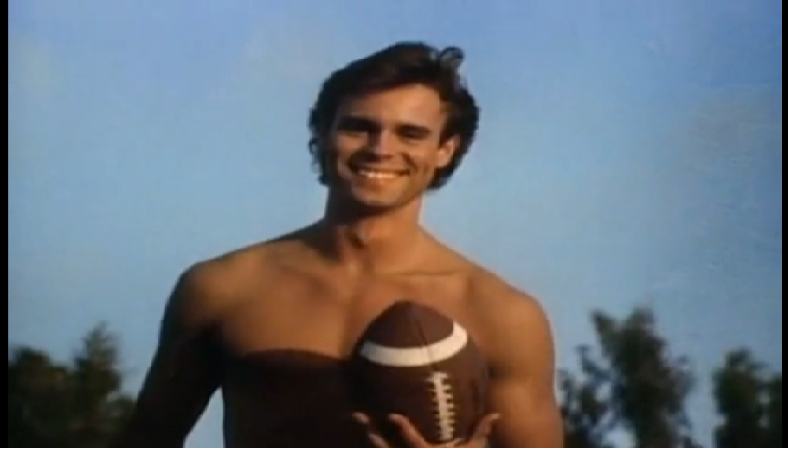
There is clearly a relationship between Courtney's pure, one could say socially-sanctioned sexuality, and the violent sexuality that terrifies her. Whenever she begins to fantasize about Matt, the rocker intrudes. What this seems to suggest is that the ordeal she survived in the first Massacre has affected her ability to engage in a mutually satisfying sexual relationship; she instinctly transforms it into a sadomasochistic relationship. A slight twist on this point, she may just on some level perceive all male sexuality as destructive, all female sexuality as trapped in sadomasochism. In the first film, Courtney, still a young girl, witnessed a man sticking a phallic drill in nubile girls wearing skimpy clothes. This image seems to have impressed itself upon her as the only course sexuality can take. By the same token, she automatically punishes herself for her sexual desire. She seems unable to cope with a sexual desire that is as pleasurable for her as it is for the male.
At the level of fantasy, Courtney's negative dreams are much like bondage: an attempt to transfer what one fears into an environment one can control. While often viewed as a perversion, bondage is little different than a man with a fear of heights going skydiving. Courtney dreams of the rocker so she can, on a subconscious level, deal with her fear of her own sexuality impressed upon her from the first Massacre. As the fantasist of a rape fantasy doesn't really desire to be raped, Courtney doesn't really desire to be subject to the driller-killer's terrorism.
At the beginning of the film, Courtney is seemingly in control of these dreams. Like any dream, they run without explicit control. Yet she's cheerful and undisturbed as she eats her breakfast. Once she leaves home and sees a dead bird--just as in her dream--she begins to worry that she's lost control of her comforting fantasy. As the film goes on and sexuality begins to impinge upon her more and more, her hallucinations increase in frequency. After she overhears her friend having sex, she hallucinates her bathtub filled with blood and then her friend's head overtaken with a gushing zit. These are all revealed to be hallucinations, much to her relief and dismay.
(Note: Major Spoilers from here on.)
The turning point is when, finally, her dreamboy Matt takes her to bed. When her positive dream becomes a reality, so too does her negative dream. By allowing herself to engage in sexual pleasure, she releases the sadomasochistic fantasy into reality. The killer immediately drills through Matt, destroying Courtney's hope for a normal sexual relationship. He pursues Courtney through the house, singing his lines and performing sexualized rockabilly dances while terrorizing the girls. The editing becomes expressionistic, giving him little music videos. This shows he's in control; he's no longer a subconsciously contained fantasy, a safe exploration of danger and fear. Gradually he manages to drill through everyone until it's just he and Courtney.
For better or worse, Courtney is unable to embrace this aspect of her sexuality. The film doesn't make entirely clear where it stands on this subject and it is by no means self-evident. As noted, the sexuality Courtney has with Matt is a mutually satisfying one. One might therefore assume the film is against an abnormal and sadomasochistic sexuality. However, feminist filmmaking is characteristically against perceptions of what's normal or abnormal in sexuality. Matt is, after all, a very much socially sanctioned object of female desire. Perhaps the driller-killer represents a fear of her more adventurous sexual interests that ought to be embraced. At one point he states, "You and I are one until we go all the way." Courtney's sister (in her dreams), however, says, "Don't go all the way!" In the context of the genre, though, I would suggest that the film can be taken at face value. The driller-killer, in the lineage of slasher villains, is an essentially patriarchal force that exploits females and denies them the right to their own sexual pleasure. Feminist writers, like Carol Clover and Linda Williams, have made much of this, from the phallic choices of weapon (although, what weapon isn't phallic?) to the relentless pursuit of girls engaged in sexual behaviour and the ultimate survival of the virginal heroine. This was made more explicit in The Slumber Party Massacre than any prior slasher; and Slumber Party Massacre II makes it even more explicit, indeed, as I've been showing, the very central dynamic of the film.
The film's final shot, to some very disappointing but to us the most interesting of all, reveals the whole film to have been a dream. Valerie Bates is not the sister in the mental hospital, but rather Courtney herself. Suddenly that throw-away line about the mind dealing with trauma seems all the more relevant. Cowering in her hospital room, she imagines the driller killer piercing her room--a visual euphemism for penetrating her, of course--just as she's imagined all we've seen in the film. Had this not been the case, the fantasies of the ideal Matt could be chalked up to a reflection of reality. However, once we realize there is no Matt, we see he's a purely idealized vision of a young woman's sexual desires. He's infinitely attentive to her needs, impossibly handsome, and while talking on the phone wears nothing but cut-off jeans and poses like a poster boy. Brock, moreover, directs the film such that Matt is consistently represented in a dream-like manner, with strange, subjective shots of him looking into the camera.
The intrusions of the driller-killer are thus not just about sexuality. A normal sexuality is co-extensive with a normal life altogether, which the traumatic events of the first Massacre have prevented Courtney from enjoying. The sadomasochistic fantasy perverts not just her sexuality but her whole world. He destroys her friends, destroys her romantic dreams, destroys her boyfriend, till it's only him left in her world. Her final attempt to exorcise him from her dreams with fire is a failure. If the film represents her struggles at self-therapy, the therapy fails; she remains a frightened, broken girl in her hospital room.
Sexuality is central, however, because just as the events of the first film are contained within a highly sexualized slasher format, so Courtney's means of dealing with the events are themselves contained within a sexualized slasher--albeit from a notably more feminine point of view. Brock is able to engage, in this way, not only slasher genre tropes, but also criticisms of the genre. In her 1984 essay "When the Woman Looks," Linda Williams argued that any woman who dares to grant herself the privilege of desire in a horror film is punished with her own reflection in the monster, a creature of abnormal power, and simultaneously victimized by it. If this dynamic is what Courtney witnessed in The Slumber Party Massacre, she's now internalized the experience and is cursed to perpetually punish herself in her own dreams for exhibiting sexual desire. The first-person relishing of the beautiful Matt is an instance of female gaze, female desire enjoying the spectacle of a beautiful male. It's genuine and not salacious; it is, for once, female pleasure acknowledged in a slasher. For this Courtney punishes herself, having internalized the slasher dynamic.
Moreover, Carol J. Clover's 1987 essay, "Her Body, Himself," which Deborah Brock could conceivably have read prior to writing Slumber Party Massacre II, argues that the 'Final Girl' in the slasher film, the girl who survives the ordeal, is purged by her experience. The most self-denying of the female characters, virginal and serious, usually a tomboy, the Final Girl is stripped through the horrifying experience of any desire to seek out pleasure for herself. Courtney was already a Final Girl. In this film, she's dealing with the results of this purgation. As I've noted, Courtney punishes herself for fantasies of mutually satisfying relationships. These fantasies pervert themselves into sadomasochistic relationships with a primal male sexuality she can't control. In an instance of Freudian repetition, she's forever reenacting in her fantasies her own ordeal as a Final Girl, repeatedly purging herself of her healthy sexuality. But the purgation, in Brock's film, is itself extremely unhealthy and leaves the female with an unbalanced, pathological sexuality.
The film's message, if we may call it that, is not that women watching slashers will, like Courtney, internalize the sexual dynamic and become sexually unbalanced. Courtney witnessed the Massacre from inside, not safely projected on a screen or popped in a DVD player as we do. (Although the names of the characters--Bates, Voorhees, Krueger--suggests Courtney's watched her fair share of horror films.) But if slasher films are to some extent reflections of a social disorder, a disorder based upon repressing female sexual liberty, then Slumber Party Massacre II suggests the dangers of propagating such a disorder. Film is a very powerful medium and what viewers of that medium can and will assimilate would astound. Freedom of sexual desire is sexual health.
Halloween 2 (2009) - 3/4
Halloween 2 is without a doubt a confused and messy film. There are a few reasons for the mess. For one, Michael's behaviour and motivation is inexplicable unless one has seen the first film. Halloween 2 is more continuation than sequel. Where Halloween's strength is in how Zombie grapples with the influence of John Carpenter and asserts his own interests, Halloween 2 reveals a more confident artist, now over his struggle with Carpenter and taking the material into a grapple with a horror cinema in general. Zombie is, in this film, free to assert his own themes and to be as brutal as he wishes. Halloween 2 is consequently both a much more flamboyant film and a much grittier, bloodier, darker film.
There are really only two ways to grapple with the history of one's field: to ignore it or to appropriate it. Zombie appropriates. Caroline Williams is cast as a doctor in the hospital scene, referencing an even more over-the-top sequel, Tobe Hooper's The Texas Chainsaw Massacre 2. Margot Kidder's character is named Barbara Collier, referencing her character as Barb in Bob Clark's Black Christmas and her role in DePalma's Sisters, the protagonist of which is named Grace Collier. There's a Frankenstein's monster, a song about Terror Train, a guy dressed as the Vincent Price character from Madhouse Dr. Death, a guy dressed as Teen Wolf, Laurie and her friends dressed like characters, and so forth. Rocky Horror Picture Show. There's considerable bravado in all of this; despite being appreciative tributes, Zombie is clearly calling these light horrors compared to his own brutal vision. For instance, the Frankenstein's monster is attacked mid-coitus and the Teen Wolf mid-urination. Halloween 2 is, however, less anxious about its appropriation than Halloween. The appropriation is equally a celebration of horror history and a way of demolishing its presence in Zombie's creative mind with his monster, the perfect monster, Michael Myers. He even jokingly pokes at Marxist and Freudian readings of horror films, with the old '70s Marxist named Meat getting ridiculed and Loomis's lame Freudian jokes. Hopefully Zombie has at last worked out his anxieties with this picture.
The second reason for the messiness is due to a major theme of the film: self-importance. Nearly every character is entirely absorbed within his or her own problems and interests. A year after Myer's first attack, Dr. Loomis is now a best-selling author, capitalizing on the fame of Michael Myers. He only cares about his book deals, abuses his assistant and makes tasteless jokes about Michael Myers to the agony of those Myers has hurt. Laurie is now a psychological mess, riddled with nightmares and antidepressants. She only cares about her own psychological issues. Michael, now hallucinating about his mother and a white horse as he recovers in a mountain shack, only cares about finding Laurie and assembling his makeshift family. He brutally destroys other families along the way. Even minor characters, like the strip club owner, is shown advertising his strip club by setting up a petting zoo. The film's choppiness derives in large part from the way every character considers his or her issues more important than everyone elses and pursues them self-interestedly. The only exception Zombie allows is the Bracket family. Though Annie Bracket physically suffered more at the hands of Myers than anyone else, she and her father do all they can for Laurie, giving her a home and companionship.
As with the first film, the center of Halloween 2 is really the relationship between Michael and Loomis. Although Michael and Loomis are only in one another's presence for a brief moment in this film, that moment is the true climax. I argued in my review for the first film that Michael's condition worsened as Dr. Loomis refused to leave him return to his mother. Loomis was motivated by his reputation as a hot-shot psychiatrist; he wanted to cure Michael by his own methods in his hospital and get famous for doing so. Michael needed his mom. When Michael's mother died, all hope was lost. Dr. Loomis's cynicism and self-importance is the cause of Michael's condition. Michael's motivation is to reassemble his family in a pristine state at all costs. He is given divine, as it were, command to do so by the ghostly presence of his mother, all in white, and his own child-self from the exact moment of killing his step-father and sister.
So all of Michael's kills involve destroying influences that corrupt his family. His first Haddonfield victims are the denizens of the local strip-club where his mother used to work. This purges his mother's spirit of corruption. He then targets Laurie's new friends, two hipsters, one a party girl and the other a(n implied) lesbian, freeing Laurie. The final victim Michael pursues is his archnemesis, the ultimate barrier to his family and happiness, Dr. Loomis, a moment not unlike the meeting of Harmonica and Frank in Once Upon a Time in the West. Everything both characters do throughout the film leads them together for a final confrontation. Tellingly, the only word Michael speaks in the whole film is to Loomis, at that moment: "Die!" The blood-soaked ending could well be interpreted as a happy one.
Loomis's character is easily the most fascinating presence in Halloween 2. The cynicism and self-importance that were subtle in the first film explode into blistering pomposity in this film. A beautiful scene shows him on a late night talk show, a co-guest with Weird Al Yankovic of all people. As comedians do to anyone taking himself too seriously, Al and the Letterman-influenced host destroy Loomis. The experience of the talk show pushes Loomis into self-questioning and, at last, responsibility for his role in Michael's life and murders. Discovering Michael is still alive offers him an opportunity to vindicate himself; but, perhaps unbeknownst to him, this can only be at the cost of his life.
One aspect of the film that sadly does not work as well as it should have is the presence of Michael's mother and the white horse imagery. For one, Sheri Moon Zombie looks foolish, being asked to stare wide-eyed and blankly off-screen. I can see that Zombie is going for the look of a Russian icon, but it's not working. As for the horse, the film begins with a quote telling us a white horse is "linked to instinct, purity and the drive of the physical body to release powerful and emotional forces, like rage with ensuing chaos and destruction." The horse symbolizes the whole of Michael's rage and drive to restore his family, everything that Loomis took away. Cynicism and self-importance are the cause of rage and violence, in Zombie's vision. The symbol doesn't really add anything, however, and is rather fey for a picture so full of expertly-crafted brutality. The hallucinations, moreover, gradually become shared by Laurie, touching on something the film could have done without, namely, telepathy. Perhaps there is intended psychological realism in the peronsality of a potential victim of a psychopath gradually collapsing into the personality of the psychopath; but the shared hallucinations is beyond psychological realism.
While a flawed picture, Halloween 2 stands as a powerful and disturbingly accurate snapshot of the horrors of our time, not unlike Picasso's Guernica. Halloween was too self-absorbed to depict the world. But Halloween 2 shows us a world doomed to violence and brutality by our own self-importance and cynicism. The rays of hope are found in the generosity and playful warmth of people like the Brackets and in the jokes of comedians like Weird Al Yankovic.