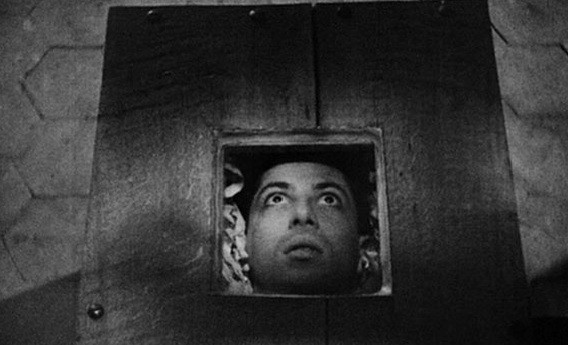
Apparently in Britain's inner cities all youth is irredeemably evil and all the elderly are kind old souls. At least that's what Harry Brown would have a North American like me believe, because it depicts a nightmarish world where gangs of young men coincide on a random target and mete out horrendous violence. Perhaps this monochromatic world was necessary for the social criticism(s) at hand; but perhaps a more subtle social criticism is lost along with this ambiguity.
Harry Brown is about a pensioner (Michael Caine) who lives the most mundane life the writer-director could conceive an old man named 'Harry Brown' leading. His long-comatosed wife has just died, a gang of youth has murdered his best friend and now the sympathetic homicide detective Frampton (Emily Mortimer) tells him it's possible the murderers will only get manslaughter. Harry, a veteran Marine once stationed in Norther Ireland, decides to take justice into his own hands and what ensues is a pretty brutal thriller as Harry hunts down any thuggish sort he spots in the group by the subway tunnel, whether they were involved in his friend's death or not.
Director Daniel Barber certainly encourages the viewer to sympathize entirely with Harry's mission. The first twenty minutes of the film heap upon Harry all the geriatric pathos that could be mustered and then some. Each youth is shown to be so irredeemably heinous that we the audience are implicated in the their murder by approving of Harry's actions. I found myself torn between my moral sense that these are young men, nearly boys, who never had much of a chance in life and the film's encouragement that I be thrilled Harry is taking out the trash--and these people are trash, believe me. Only a single character, Frampton, who perpetually looks like a puppy who just got her paw in the door, voices any moral concern; the film does not come down on her side. It is entirely on the side of the vigilante. There are two parallel scenes that show the ineffectuality of police interrogation compared to Harry's interrogation. That's where Harry Brown the film stands.
The overwhelming message of the film is that these young thugs have no purpose, no cause; they're just bored. All the crimes they do are done for entertainment. They record murders on their phones to watch for amusement. They record rapes. The get kicks out of threatening to shoot a mother pushing her stroller. Harry, as a veteran, represents a time when violence was used for a cause and when that cause is gone, it stops and is compartmentalized. To Barber's credit, however, he doesn't remove all moral ambiguity. The point is raised, but not given much attention, that Harry is killing people who had nothing to do with his friend's death. They are killed simply out of Harry's moral outrage. Of course, one wonders if justice for a seventy-five-year-old man really warrants the deaths of half-a-dozen twenty-year-olds. Could that really be Harry's full motive? I doubt it; this isn't a pure revenge picture. There is also a lingering question that is never explored: Harry never does wait for the police investigation to conclude; he simply turns vigilante. Once he has the evidence on the cell phone, he can prove that it was at least second degree murder. Instead, he keeps on with his vigilantism.
There are two things that makes the film, with its harsh worldview, work: albeit morally questionable it is undeniably entertaining to watch Harry hunting and overpowering these scummy characters. But most importantly, it has Michael Caine. Despite the pathos overload in the first act, which even makes the elementary mistake of showing Harry crying--twice!, Michael Caine's exceptional performance makes it work. Harry is a man burdened with moral anguish and he feels the responsibility to do something about it, despite his tired, old body's reluctance. So he locks himself into his old, wartime mentality. It's not the most subtle character Caine's ever interpreted, to be sure, which makes the subtlety Caine himself brings to the role all the more welcome. When Harry is at his weakest, Caine conveys his inner strength and when Harry is at his most dominant, Caine conveys his fragility.
This is Barber's first feature, but his confident style shows his abundant experience from directing commercials. He's certainly a name to watch out for. Harry Brown is a remarkable debut feature.
Help make this site more interesting through discussion:
Harry Brown (2009) - 3/4
Author: Jared RobertsNew Town Killers (2009) - 2.5/4
Author: Jared RobertsWouldn't it be original to show a rich sociopath mercilessly hunting down the poor for entertainment? Oh, it's been done? Yes, of course, New Town Killers is an old story and not one that thrives on subtlety. It's The Most Dangerous Game and its many incarnations crossed with the image of the wealthy man who believes he can get away with murder. Just because it's an old story, however, doesn't mean it can be told very well and that's just what Richard Jobson does in New Town Killers.
Alistair (Dougray Scott) is a wealthy, powerful banker who occupies himself on weekends with human-hunting. Particularly, he likes to choose impoverished teenage boys. He offers them money to play the game without explaining the stakes. Once they agree, it's too late: it's run or die. This time Alistair has chosen Sean (James Anthony Pearson), a sweet boy who tries his best to support himself and his irresponsible older sister. Now Sean has to use his wits to escape the murderous sociopath in the hour-long chase sequence.
The heart of New Town Killers, as the title indicates, is Alistair Raskolnikov (get the reference?). Dougray Scott gives his all in making a truly frightening villain. Much like Ripley in Ripley's Game (in which Scott played the protagonist, coincidentally), he has a sociopathic philosophy, Nietzschean in flavour, that stipulates the absence of limits. There is really nothing Alistair wouldn't do: morality, loyalty, humanity are all limitations Alistair refuses to allow to encroach on his practical reason. Unlike Ripley, however, Alistair isn't goal-oriented. He's dead inside. Ripley is someone you can love in spite of yourself because he has a rich inner life of some beauty. No-one could love Alistair. He compensates for his lack of an inner life with his violent games and undirected hate.
While I find Alistair fascinating as a monster, Jobson obviously intends him as a representation of the predatory rich. He has a lengthy and rather disturbing rant about the uselessness of the lower classes, their unimportance, the banality of their existence. He seems to equate people knowing you exist with an abundance of existence itself, as if his wealth and power over a few dozen people makes him more real. This is perhaps interesting as a character study, but as social criticism, it's egregiously out of date. It might fit the industrial age, but today, in the information age, the wealthy tend to be socially conscious philanthropists and kind, gentle people. Resent Bill Gates as you will, but he's no heartless monster. Or perhaps it is merely intended to say that the rich prey on the marginalized and have no concern for their well-being. That's not a particularly insightful message.
The social criticism doesn't really matter, however, because what New Town Killers offers is a taut, edgy thriller that works very well. It quickly sets up its characters and their situations, then the chase is on and few frames are wasted, save some pointless jump cuts. Once you realize Alistair could do anything, his mere presence on the screen becomes frightening. Pearson, too, should be applauded for making Sean a truly sympathetic character whose resourcefulness always seems reasonable. The chase dynamics between these two should keep even experienced chase-movie fans on the edge of their seats. Edinburgh proves to be a fantastic concrete jungle for the nightmare to progress.
Categories: 2009, thriller at 7:35 PM 0 comments
The Possessed (2009) - 0/4
Author: Jared RobertsFor the first time since I've been reviewing films, I have left a film before it was over. The Possessed immediately strikes one as a harmless documentary in the style of "Unsolved Mysteries", with reenactments and real interviews intercut. The more one watches, however, the more one is assailed with morally objectionable material until I became too offended to watch on.
The story itself is an interesting one and I had previously read about it on the rather entertaining website www.mysteriouspeople.com. Mary Roff, a disturbed woman subject to seizures and quasi-religious mania dies in her adult years. Lurancy Vennum, an unrelated girl who was two-years-old at the time of Roff's death later begins exhibiting similar behaviour and claims to be Mary Roff. The film debates over whether it is possession or some sort of retroactive reincarnation. The title tells you what side the film falls on.
That the documentary falls on any side at all is the first of its problems. The filmmaker/interviewer is Christopher Saint-Booth, a bizarre-looking hippie who dresses like a cowboy resembling Johnny Legend circa 1985 sans coolness. He buys into all of this crap, unsurprisingly. This might not be a problem for me in a harmless haunting documentary, but this documentary is dealing with troubled people--almost all young ladies--who need help and that help is certainly not the Catholic Church nor a Crystal Healing Bed!
You see, for Saint-Booth to make his points, like a lawyer of sorts, he references related cases as if these precedents are solid proof. He references the case of Anneliese Michel as if it's a proven precedent of possession. Actually, the case of Anneliese Michel went to court and the exorcists were charged with manslaughter![1] And here's the moral crux: Saint-Booth also references the cases of some still-living people who believe they were possessed. They used to cut their arms, were obsessed with their own blood, and sometimes tore their own skin away. The fact that Lurancy Vennum also did this, Saint-Booth concludes, shows that she too was possessed. Actually, it shows they all had the same psychological issues and they were in desperate need of real treatment, not wackjob charlatans. Unfortunately, Saint-Booth encourages their manner of reasoning and that is what makes this documentary thoroughly objectionable.
He began to interview a young man who had been exorcised by his mother, a religious fanatic who clearly had seen The Exorcist way too many times, because the exorcism she videotaped showed her speaking lines from the film verbatim. That's when I turned the documentary off. This is an ignorant, irresponsible, morally bankrupt documentary from which you will learn nothing you can't read online.[2] The parallel cases are somewhat interesting, as they were recent and I'd never heard of them before; but they were sadly mishandled by an agenda-driven believer.
1. http://en.wikipedia.org/wiki/Anneliese_Michel
2. http://www.mysteriouspeople.com/Lurancy_Vennum.htm
Categories: 2009, documentary, horror, worst at 7:33 PM 0 comments
The Lodger (2009) - 3/4
Author: Jared RobertsThe Lodger is one of the most confusing instances of plotting since The Big Sleep. I mean that mostly as a compliment. The film maintains so many possibilities until the final moment that the audience is forced to give up trying to figure out what's really going on and just observe and accept what's shown; no point trying to puzzle out the how once you know the who, because it won't get one anywhere.
Chandler Manning (Alfred Molina) is a detective with the LAPD. He's a rude, unpleasant fellow whose controlling behaviour has put his wife in the hospital with severe depression, but he's good at his job--or so it seemed. He had a man executed for murders and now the same murderer appears to be killing again in the style of Jack the Ripper. Just as the killings begin, a neglected housewife (Hope Davis) takes a lodger (Simon Baker) for extra cash and begins to suspect that either this man or her nearly-always-absent husband (Donal Logue) is responsible for the string of prostitute murders.
There are several things The Lodger does right. For one, it is never predictable. A lot of the scenes one expects to occur never do and a lot of scenes one would never expect happen. Ondaatje, who directed and wrote the screenplay, takes the story in unexpected directions. He also does excellent work on building the relationships amongst the characters. Each one of the major characters in this film is an obsessive; they're all obsessed with something and the obsessions make them who they are as well as destroy their chances at stable relationships. I would go so far as to say The Lodger is about obsession; obsession in the tradition of Visconti rather than Hitchcock.
It's also a film about suspicion. Everyone in this film is suspicious of everyone else. The landlady suspects her husband and the lodger, her husband suspects her of going mad, Manning himself becomes a suspect to the FBI, and so on. There is very little trust amongst any of these people. They're all burdened down with paranoia and the film imparts this paranoia to the audience with one red herring after another. There are so many possibilities that the audience is woven into the paranoia and we begin to suspect all of the characters too. It's like being in the mind of a Jack the Ripper scholar--and we do meet one in the film--to whom at least a dozen people could be responsible for the murders. But when everyone is a suspect, how to narrow the search to the right one?
The depiction of male-female relationships in The Lodger is also worth noting. As one might expect, the neglected and verbally abused housewife falls for the mysterious lodger; but there are dimensions in that relationship that far exceed expectations. The murders are particularly vicious, although the film is too tasteful to do more than describe them: the prostitutes have their sexual organs removed. Manning's dying relationship with his wife and daughter is explored in some detail. Most of the women in the film are on medication. What does it all add up to? I don't know, but I do know men don't come out of it too well.
While The Lodger is a decent film, it has an unfortunate, tacked-on ending. Ondaatje should certainly be applauded for keeping so many balls in the air at once, if not for his unnecessary stylistic noodling. There is a lot going on in The Lodger at all times, yet neither the pacing nor emotional tenor is lost for a moment. As the thriller courses along as a good thriller, it builds a web of irony so clever I readied myself to call The Lodger one of the year's most interesting. Then the final two minutes unravels all the irony. It is still a good thriller, but it could have been a very good thriller.
Categories: 2009, horror, thriller at 7:30 PM 0 comments
Hurt (2009) - 2/4
Author: Jared RobertsHurt is a standard American Gothic evil-orphan-girl picture with the ambition to say something, an ambition that's subverted by its chosen exploitational format.
A complicated family situation is made more complicated by the arrival of a foster child. A woman (Melora Walters) has two nearly-adult children and they're all moving in with her childhood foster brother. He's offering her a place to stay at his home/scrap metal yard while she awaits the forthcoming compensation money from her recently-deceased husband who was her other childhood foster brother. Indeed. Before her husband died, it seems he had been trying to adopt a young girl (Sofia Vassilieva) into his family to get her away from her abusive mother. Strange events ensue. Of course the audience knows it's the girl, so it's only a matter of how long until the characters find out and of why the girl is doing it. And you can probably guess the latter already.
Writer-director Barbara Stepansky does have something to communicate about how family members can hurt one another, in ways as obvious as physical abuse and more subtle ways like irresponsible spending, disregard of property and privacy, or neglect. These are Gothic themes. And in good Gothic fashion, with a modern hint of feminist awareness, we see a family torn apart (almost literally) by the hurt(s) beneath the surface. It's difficult to guess at how radical a claim Stepansky is aiming for: the oppression of traditional family forms? the horror of "broken" families? The naturally exploitative mould of a horror film makes it difficult to say, as we the audience are encouraged to be horrified by the little girl when the themes appear to be heroizing her. The form is working against the matter. The most curious thing about the story, coming from a female writer-director is just that the absence of the patriarch is the catalyst for all the horror.
As a horror film Hurt is not terribly successful, nor is it terrible. It is more of the same without much distinction or inventiveness. The weakest member of the family becomes suspicious of the brat, who is busy with increasingly malicious mischief until she can strike. There are no surprises to be had. As is often a problem with these films, the little girl comes off as far too mature. Vassilieva was seventeen at the time and it shows. Her voice and manner, as well as the dialogue written for her, are beyond any pre-pubescent girl. This is particularly true when she begins to explain her motivations: those words sound more like the screenwriter's motivations to me.
The acting is always the last thing to fail in a film and that's no exception with Hurt. All of the actors, especially Vassilieva, despite playing a character far too young, do very well in their roles. Anyone who has dealt with foster children knows they can be quite manipulative; Vassilieva captures that, down to the parted-lipped glares and casual snooping. The more dialogue and absurd activities she's given, however, the more difficult it becomes for acting to save the character from seeming the silly artifact of a screenwriter.
The title of course gives the game away: Hurt isn't about any particular character but about the myriad ways to hurt in a family context. In Hurt, most of those ways involve scrap metal.
2/4
Categories: 2009, horror at 7:29 PM 0 comments