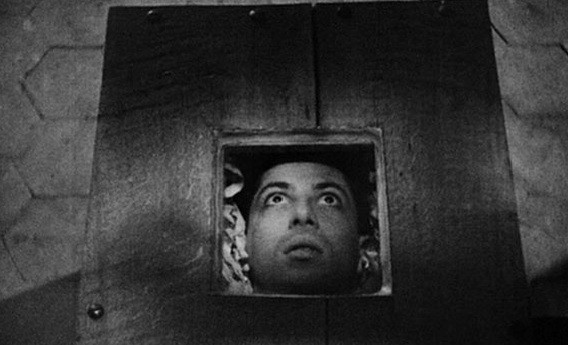
David DeCoteau's House of Usher falls in a long tradition of "The Fall of the House of Usher"-adaptations. Jean Epstein's La chute de la maison Usher and Watson and Webber's The Fall of the House of Usher are both avant-garde classics that take advantage of the non-narrative aspects in Poe's writing. Roger Corman's House of Usher is a classic of horror cinema that follows Poe's narrative to mine its symbols for their psychoanalytic connotations. DeCoteau's Usher, written by Simon Savory, falls somewhere in between Corman's and Epstein's visions. DeCoteau's Usher is a deliberate attempt to put the potentially therapeutic nightmare of a psychologically damaged mind on screen, making narrative superficial and subordinate to the psychological symbolism.
It's worth looking at how DeCoteau's Usher is distinguished from previous adaptations. In Epstein's Usher, the visitor to the house of Usher is an elderly acquaintance of Roderick's who is not even named. He is merely a witness to the events surrounding the fall of the house. Complementing his role as witness is the variety of sensory malfunctions Epstein gives him: he uses an ear trumpet to hear and suffers presbyopia. He's not only a witness, but a bad witness to a distinctly Usher world. None of the visitor's personality enters that world, but his flaws of perception alter how we receive it. In Corman's Usher, the visitor is named and while he too is a witness to the Usher world, he's too indignant to witness it passively. He is not a friend of Roderick and in fact only meets him in the first act. It is rather with Madeline that he has a relationship, a romantic one as it happens. To save Madeline, he actively effects change in that world. In DeCoteau's Usher, the visitor, Victor Reynolds (Michael Cardelle), takes priority over the Ushers themselves. The world he enters is distinctly his nightmare and not a nightmare he has entered by accident. Not only are his senses sharp, but the Ushers tell one another that he has the power of "sight," a sort of psychic vision into the house's otherworldly aspects. His power of sight is not that of a detached observer, but of a creator. The house of Usher is a Reynolds world populated by Ushers.
So, where Corman was able to leave the supernaturalism of the house ambiguous and merely a manifestation of Roderick's troubled mind, DeCoteau doesn't have that recourse. There is no objective witness. If the house is a manifestation of a troubled mind, it is Reynolds's mind. However, it is also through Reynolds's mind that the whole film is seen. The house of DeCoteau's Usher really is a vampiric entity in symbiotic relationship with the Ushers. They and the house grow weaker until the house is able to consume victims. Thus is Reynolds summoned to the house in capacity as both saviour and victim of the Ushers. It is by Roderick (Frank Mentier) that Reynolds is invited, not merely an old friend but his former lover in a relationship that ended when he enlisted in the military. Both Roderick and Madeline (Jaimyse Haft) tell Reynolds in private how much he's needed, making his importance very clear; yet it is nebulous just why exactly he is important. While it initially seems he is there to liberate the Ushers from the house, they eventually decide he must be sacrificed. Their decision doesn't proceed so much from any narrative or character developments as much as by the dream logic at work.
The nightmare Reynolds finds himself in is interesting for being more sexual than violent. I referred to DeCoteau's The Pit and the Pendulum, made a year later, as a psychosexual horror. House of Usher, while not as pure, falls in the same category. On Reynolds's first night in the house, Roderick wastes no time stripping and making out with him for a few minutes. Reynolds ends the session when the moment of penetration comes dangerously near. He is molested by the hands of ghosts in a bathtub. He has visions of ghostly muscular men in underwear warning him to flee. Each of them were victims of the house, yes, but also of Roderick's camera. It is as if Roderick's look of sexual desire captured their souls. Madeline also attempts to seduce Reynolds with some ferocity, but falls into a cataleptic state before she can get his pants down to fellate him. It is as though Reynolds is forever approaching sexual moments, but being prevented or preventing himself from fulfilling them. Or rather he is being both tantalized and reproved with fruitless sexual relationships. Madeline is given a speech about a ghost child she believes haunts the house. It's not the ghost of a child that died, but the ghost of the potential child her barren womb can never realize, "For every woman there is a child waiting to be born," she says. This is an expression of conventional sexuality: the idea that we must "be fruitful and multiply." She adds, "I fear the unborn far more than I fear the dead." So both Roderick and Madeline are viewed as haunted, Roderick by male sexual conquests he's sacrificed to the house and Madeline by her infertility. Both are haunted, then, by their fruitlessness. Reynolds's importance to the Usher's therefore seems to be the possibility of fruitfulness, but ultimately the vampiric barrenness of Usher means he can only be a saviour through sacrifice.
Reynolds's sexual reticence and his status as sacrificial victim has mystical connotations. From early in the film he can be seen wearing a cross. Roderick draws explicit attention to it. His role as both saviour and victim makes him Christ-like. The Ushers, however, have a distinctly pagan quality. They must continue to sacrifice victims to the house. The relationship of Roderick and Madeline to the house is an interesting one. Despite their concern for Reynolds, they compulsively perform the sacrificial ritual. They have no fruitfulness outside of the destruction of others. Where Corman deliberately shot the exteriors for his Usher where there had recently been a forest fire, the grounds of DeCoteau's Usher contain a lovely garden. Madeline explains the garden is over the family burial grounds. There is no growth without death for the Ushers. But the house is insatiable. Their sacrifices must be endlessly repeated. They are held captive to it, but it's not clear why. Freud considered compulsive repetition to be a particularly destruction reaction to feelings of guilt. In this case, it is Reynolds's own feelings of guilt about his fruitless sexuality. One is reminded of how Pope John Paul II referred to birth control and pro-choice as a "culture of death." Reynolds is able to deny his own sexuality and project it onto the pagan, parasitic Ushers while he remains a Christ-like victim.
A distracting aspect of the film is that it's just a little too precious and fresh. The house itself is a newly-built modern manor. One would expect a grotesque and delapidated old mansion. It is implausible that this house is in the process of falling to pieces. The actors are also too young for the roles they are asked to portray, with the exception of Madeline's Jaimyse Haft, who gives the film's best performance. Roderick looks like he would still get carded at a pub. They are also all extraordinarily attractive. Even the butler and the ghosts are studly young men. I can't deny the pleasure of looking at these faces and bodies. It is an enjoyable part of the film, of course. But in DeCoteau's The Pit and the Pendulum there is a good reason for having only attractive people and the pleasure of looking at them integrates with the content of the film. In House of Usher, there is no internal reason for the attractive cast. Nor does the enjoyment of these bodies integrate with the film's content.
House of Usher is the second of DeCoteau's Poe films I've seen, though it was made before The Pit and the Pendulum. He also adapted The Raven in 2007, which I have yet to see. In the two I have seen, I've been impressed by DeCoteau's and Savory's experiments in sexualizing Poe's narratives. From the expressionistic and symbol-rich material of Poe's stories, they've created nightmares with which to explore psychosexual depths. The narrative-light content of Poe's stories allow the space to make such explorations. The Pit and the Pendulum is something of a masterpiece. House of Usher is not as sure-footed, but is still a fascinating psychosexual nightmare from which we might experience a little catharsis. In following its own unique path with the many permutations Poe's story permits, House of Usher proves a worthy entry in the grand tradition of House of Usher films.
Help make this site more interesting through discussion:
House of Usher (2008) - 3/4
Author: Jared RobertsThe Pit and the Pendulum (2009) - 4/4
Author: Jared RobertsPoe this is not. But then, what Poe adaptation ever is? From Jean Epstein's La Chute de la maison Usher (1928) through Roger Corman's classic Poe films, Poe has been to cinema what he was to the Symbolist poets: a wealth of symbols with which to manifest the subconscious. David DeCoteau's The Pit and the Pendulum is perhaps the farthest of all incarnations from Poe's original narrative, but it falls in that same tradition of manifesting the subconscious.
Poe's "The Pit and the Pendulum" is a very short story about a man strapped beneath a bladed pendulum on a platform surrounded by pit. He reflects upon the mechanism as it swings gradually closer until he is rescued by soldiers in the last moment. Corman's The Pit and the Pendulum involves the mechanism, but locates it in the neglected family torture chamber around which the melodramatic story is constructed. DeCoteau's The Pit and the Pendulum just about dispenses with the mechanism altogether. The pendulum is a pocket watch in the hands of the mad hypnotist Jo-Beth Divay. She's experimenting with the permanent removal of all pain and fear through hypnosis. Unfortunately, her techniques involve causing extreme pain while under hypnosis. She leaves that part out of her ads, however, which promise superior physical performance in athletic endeavours. Hence the collection of beautiful bodies, both male and female, that submit to her experiments.
To some extent, the point of The Pit and the Pendulum is the enjoyment of beautiful bodies. A nearly five-minute scene of two exquisite male bodies wrestling in tight, black underwear makes this point clear. One of this men has a shaved head and larger muscles, whereas the other is more lithe and 'cute.' Another attractive man strips to his underwear to lift weights. He resembles a figure from an El Greco painting, elongated and darkly beautiful. The two gorgeous young ladies never strip, but their scant clothing and beautiful faces offer plenty to the eyes. One is a model blond beauty. The other is a porcelain-skinned redhead with one eye seemingly smaller than the other; the quirk, easily perceived as an imperfection, makes her all the more stunning. Jo Beth as well has a sophisticated beauty, not to mention cheekbones you could chop vegetables on. She strips down to just her panties and boots, offering a slightly older woman's tight, dainty body for display. There is also a callow blond man and his handsome suitor, both of whom can be seen in underwear. Their appearances are more boyish, particularly the blond. These people are nice to look at. They give visual pleasure. And all in different ways. There should be a body for everyone to appreciate in this cast. The connoisseur should appreciate them all. As they are all athletes, there is a good reason they are all toned. So one needn't feel manipulated. One is free to enjoy the forms.
The reason enjoying the bodies is important is because The Pit and the Pendulum is a psychosexual horror film that significantly involves taking pleasure in beautiful bodies. DeCoteau sublimates violence and horror into sexual pathology. The title of Poe's story, after all, can just as easily be able the female and male genitalia. The vagina is a pit and the penis is a pendulum. The young athletes of the film enjoy and appreciate one another's bodies as much as the audience. Just about everyone in the film "swings both ways" like a pendulum. In the two-day stay at Jo-Beth's manor, most do end up exploring at least one other person's body or expressing a desire to do so. The two young women engage each other sexually, two of the young men engage each other, and two other men get to have physical contact with the women. It is only Jo-Beth who is unable to enjoy the bodies. She is either absent or at a distance.
The vagina becomes a dangerous pit and the penis a dangerous pendulum only in the face of repression and oppression. Jo-Beth is trying to remove the experience of pain from her subjects and is herself unable to experience pain; but the experience of pain and the experience of pleasure are intimately linked. They are two sides of the pendulum. Jo-Beth thus becomes the monstrous center of the psychosexual horror. While she watches the muscular men wrestling, she begins to strip and fondle herself. She does so not out of enjoyment of the bodies or the erotic value of their grappling, but from the increasing violence and the potential for death. Her only sexual satisfaction comes from inflicting extreme pain in hypnotic sessions. She suffers from loneliness as she seeks a partner who can take infinite punishment, but finds there is no such being, no-one like her or no-one like she imagines herself to be at any rate. She is, in some sense, the patriarchal standard of female desire, without pleasure of her own; her desires are perceived as dangerous and destructive. As Linda Williams argued, horror films permit female desire only to "demonstrate how monstrous female desire can be." (1) At the same time, her sadism is a masochism. The fulfillment of her desire is co-extensive with the destruction of her desire. She desires most of all a man who is like her, but realizing that man destroys him. Her only pleasure is therefore in the destruction of her own potential source of pleasure. Denying herself gratification compulsively is the only means to gratification she has. It is an endless cycle of masochism and from the masochism comes the sadism.
Jo-Beth is a generally fascinating character. She's the only character really more than just body. Her personality is large, her subjects' small; her sexual persona dwarfs them. When they first meet her they line up in her den obediently, awaiting their turn to speak. One would expect these beautiful bodies to be totally confident, but they are strangely childlike before her, like Guildenstern and Rosenkrantz before Hamlet. Sexuality oozes from her as they do from a sexy schoolmistress. Her sexual energies dominate them. Yet she herself is unable to enjoy her own sexual potency except through sadism. She has a number of terrific monologues that reveal something of her depths, particularly a lollipop-aided speech about the glory of mechanical clocks and a discourse about cactii. Like Vincent Price in Corman's Poe films, she has these odd quirks, like collecting cactii and clocks. Though actress Lorielle New is not the thespian Vincent Price was, she has great screen presence and sexily channels Price in the peculiar role with success.
Besides Jo-Beth's monologue, the clock motif carries on throughout the film. Clock faces are superimposed over each hypnosis scene. Jo-Beth explains that each person has an interior pendulum, like the pendulum of a mechanical clock, that is continually moving one toward the pit of death. Poe's story is thus interpreted as not just about sex, but about mortality. Jo-Beth sees her project as being about conquering death, as if she can stop the internal pendulum and thus hold off the pit indefinitely. Many of the characters, moreover, engage in risk-taking behaviour, such as storm chasing; this is what in psychoanalytic terms is death drive behaviour. Sex is the recourse for immortality. While these beautiful people can and do have recourse in sex, Jo-Beth, only finds sexual gratification in death.
The hypnotism in The Pit and the Pendulum is also interesting in its own right. The mad hypnotist is a cinematic villain that goes back to the first horror film, The Cabinet of Dr. Caligari. Dr. Caligari himself keeps Cesare the Somnambulist in a perpetual hypnotic trance. Each adaptation of Trilby also includes the evil hypnotist Svengali. In Karl Freund's The Mummy, Imhotep uses hypnosis. In Preminger's noir thriller Whirlpool, Jose Ferrer plays a fiendish hypnotist. Pit, however, is the first film I've seen to postulate an out-of-body experience for the hypnotized subject. The 'soul' under hypnosis descends. We see the 'soul' walk downstairs, descend into some catacombs presumably beneath the manor. This may be the titular pit. It also gives the sense of a descent into the subconscious and a bubbling up of subconscious desires, uninhibited by moral concerns. Perhaps freedom from pain and fear is a sort soullessness.
If you want a straight-forward narrative, DeCoteau's The Pit and the Pendulum is not offering it. DeCoteau isn't even trying to give a classical narrative. An extremely prolific director, not unlike Takashi Miike and Jess Franco, he can afford to make offbeat titles as he has done with this screenplay from Simon Savory. The Pit and the Pendulum is a descent into the subconscious, into psychosexual terror. Had this film been made in the silent era, with only necessary dialogue and the offbeat monologues retained for intertitles, it would be regarded as a classic today. Made in 2009, it is a good example of what interesting work is being done in low-budget, independent horror.
(1) Linda Williams, "When the Woman Looks."
Categories: 2009, best, decoteau, horror, psychological Thursday, March 18, 2010 | at 4:50 AM 0 comments
Cut (2010) - 1/4
Author: Jared RobertsIn my review of Hush, I write that a new subgenre of horror film has developed throughout the 2000s. That is the terror film. The terror film creates a limited situation, usually located at an isolated house in the country, places a group of "real" people inside the situation as protagonists and then sends a siege of murderous humans as 'monsters' against the protagonists. The motivation doesn't matter. What matters is that the protagonists have a limited number of options and the monsters have a seemingly infinite number of options. This renders the protagonists extremely vulnerable. Each of their decisions will result in terror for the audience, because each could result in death or injury. The result is unpredictable due to the semi-omnipotence of the monsters. The best and purest example of the terror film is The Strangers. Vacancy and Funny Games are also decent examples. Hush and Joy Ride combine the terror film with the road chase film, Joy Ride being the superior of the two. One comes to appreciate the art of these terror films when one is faced with an inferior terror film like Cut.
There is no question that Cut is recycling the ideas of The Strangers and Vacancy. The monsters have painted faces in the style of Vacancy. The setting is a house in the country in the style of The Strangers. The structure of the film is a by-the-numbers terror film. There is the tantalizing ringing of the doorbell at the beginning. It was a knock in The Strangers. In The Strangers, it was paced well and the girl was left alone. In Cut, there are other people upstairs and the pace is just off. The ringing comes too early and too frequently, or perhaps the problem is that the door is too close to the living room and, well, unlocked. Soon it goes beyond a ringing doorbell to breaking something. In The Strangers, a window is broken, if I recall. In Cut, it's a garden gnome or two. There's something vaguely silly about that, but it gets the point across. Eventually, a monster must make an appearance. In The Strangers, one is seen in a patch of deep-focus negative space. No attention is called to his presence; one's eyes are simply drawn to the negative space and one is shocked to discover something there that shouldn't be. In Cut, a startling sound effect tells one, "Look what we have here!" There is no thrill in discovering the danger for oneself. Then the cat-and-mouse game begins. Mostly a cat game, as the monsters seem able to slip in and out at will, just as in The Strangers. The smaller size of the house and the clumsy, roving camera makes these monsters appear as much like actors told to run down the stairs at the moment as like dangerous thugs with knives.
Then there is the issue of "real people." The terror film thrives upon giving us real people. The terror film's vision of 'real people' is nearly always people in the midst of a painful situation that involves much drama. In Vacancy it's a divorce. In The Strangers it's a shot-down marriage proposal. In Hush it's a break-up. Michael Haneke was more clever with Funny Games and gives us people who do seem real without contrived conflict. Cut put a bunch of humanizing or "realistic" character traits on a wheel and spun: a pregnancy here, a career man there, a guy with loan shark troubles, a guy trying to write a cliche horror film script. And they are all very dramatic people. They make the characters in Romero's Day of the Dead seem sedate. They never listen to one another and are yelling from beginning to end. If the "real" people in The Strangers and Vacancy with their bickering and communication problems are annoying, imagine six of them all in a small house together. Two of these characters actually managed to be decently enjoyable, due to being the least dramatic and due to the actors' screen presences. Those are the loan shark guy, Michael (Dominic Burns), and the career man, Jack (Zach Galligan, of Gremlins fame). Of those Michael is the most enjoyable. We first see him telling an uncomfortable story about a public homosexual rape with ambiguous conviction. Let's hope we see more of Dominic Burns in the future.
As always, the dominant attitude of the terror film seems to be that the major problems of our lives that seem so important are in fact so very trivial. In the face of absolute terror, in the face of the absurd threat of having one's life stolen away for no good reason in a purposeless universe, our quibbles melt away and the sense of a life unlived overwhelms. I'm reminded of the John Donne passage Val Lewton cites in The Seventh Victim, "I run to death, and death meets me as fast,/And all my pleasures are like yesterday." It is the inverse. Running from death, all one's missed pleasures are held out of view in a possibly unreachable tomorrow. Careers, pregnancies, money, sex are all such trivial things compared to survival. At least, this is what terror films imply. It's what Cut implies.
Cut also undermines its own implications by implying more, however awkwardly. There is no good reason for what happens. But there is a reason. More of a reason than in The Strangers. The tagline, No second chances tells you so much. In life, unlike in a film or game, one can't rewind or restart. One bad choice can put one up against the aforementioned absurd threat. In Vacancy and The Strangers, there is no bad choice: the threat truly is absurd. In Cut, there is more responsibility, literally and figuratively, on the part of the victims. Cut hates its own protagonists as much as I did. In fact, I probably hated them because Cut did. They had it coming. Even though they didn't, really.
As much as I try to find something worth pondering in all the films I review, as much as I try to support first-time directors, Alexander Williams's Cut offers very little to consider. Aside from Michael's story of homosexual rape and a brief movie-in-a-movie scene, there is almost no extra-narrative material to enjoy and no worldview on display. Cut briskly and single-mindedly enacts its formula; its characters and settings exist for that formula. And that formula has been enacted much better in the other films I mention throughout this review.
The Film, the World and the Fantasy
Author: Jared RobertsI.
Whatever in film is selected is elected. Whatever is elected is exemplary. And whatever is exemplary is to be sought. Selection is description, but election gives a prescription. What in a film is selected for showing to the exclusion of all else becomes a model against which reality is to be measured and if that measurement falls short the world is found wanting.
The mechanism of selection is the conjunction of the necessary definition of an exclusive world and the definition of protagonists. An exclusive world is necessary because the telling of a story involves abstracting the locations, objects, and characters relevant to the story from the total processes of reality. The positivist novelists of 19th century France believed they must follow the nature of the characters they create in the petri dish of the world they invent as rigorously as a scientist would totally predictable molecules under his microscope. The characters would follow scientific laws as surely as those molecules. All storytelling, however, involves this 'petri dish' effect. If the whole of mundane reality is included, there is no story, but merely events. A story is created not by inclusion but by exclusion. All events that do not contribute to the destiny of the exclusive world of the story are neglected. Only events deemed significance are selected and these events are selected teleologically, that is, for a purpose, be it the end of the story or the moral of the story.
The destiny of that exclusive world is decided by characters. The actions of the characters are involved within and create the shape of the events in the exclusive world. Though there may be events not instigated by characters, such as the appearance of a tornado in Twister, the event itself is an event for its happening to characters and for what actions it provokes in those characters. Since the shape of events is decided by characters, either actively or passively, and since events are selected toward the destiny of the exclusive world, the exclusive set of characters are decisive in the fate of the totality of the world. All of the actions we see them perform are thus important, insofar as importance is defined as having an evident effect on the destiny of the world. The decisions with which they conduct their lives have importance. Their relationships with one another have importance. Their living or dying, winning or losing, loving or loathing all has importance. This is the mythologizing effect of storytelling. The characters selected are not merely people, but become models of people, types, demigods like Hercules and Jesus.
Some films and television series depict worlds where the characters are making genuinely important decisions. This is often the case in science fiction and fantasy. In Lord of the Rings, Frodo's decisions really do have an effect on the destiny of the world. In Babylon 5, most of the characters make decisions that directly affect the destiny of the world. However, films and series need not be presenting fictions of literal importance. Westerns provide a good example. Take the epic western Once Upon a Time in the West. We follow a set of central characters, Harmonica the wandering man with no obvious purpose, Jill the widowed landowner, Morton the railway owner who needs Jill's land, Frank the hired assassin who killed Jill's husband for Morton, and Cheyenne the bandit who helps Harmonica and Jill. The exclusive world of West is centered upon the destiny of the land, or more specifically, Jill's ownership of the land. The film's central characters are selected for their roles in this destiny. Their actions thereby gain importance. Yet there's no inherent importance in them, as one finds in Lord of the Rings. In the context of a non-exclusive (i.e. the real) world, Jill's ownership of the land is not an evidently important issue. Were Jill murdered or stripped of her land somehow, it might make a newspaper headline, appear an injustice, but would then be forgotten. That Frank, the sadistic gun-for-hire, ultimately loses the shoot-out to Harmonica is a supremely important event in West. It is the event that decides the destiny of the entire exclusive universe. All characters' destinies are summed up in that shoot-out. Frank and Harmonica are thus titans, two highly mythologized beings. If Harmonica wins, it is the triumph of good and justice. If Frank wins, it is the triumph of evil and lawlessness. The event is gigantomachea, the most decisive event in the moral and historical destiny of the exclusive universe. However, in the context of a non-exclusive world, it is merely a shoot-out between two historically unimportant people. The death of either might not even make a newspaper headline. There were shoot-out-deaths all the time at that historical point and there would have been nothing noteworthy about the nameless 'Harmonica' or a hitman like Frank perishing. So much for selection.
When such characters are selected, they are elected for the viewing audience to admire. (Though we loathe Frank as a person in West, he is a character and not a person; to loathe him as a person just is to admire him as a character.) Their actions are important: we want our actions to be important. We are cogniscent, however, of the unimportance of our actions within a non-exclusive world. We never have an exclusive world abstracted from the activities of our lives. Our lives take place within the total network of events that comprise a non-exclusive world. Since so few events within the non-exclusive world have effect on its progress (and progress corresponds to destiny an exclusive world), very few actions have importance. Even the actions of world leaders rarely have importance. The actions of a Napoleon or a Hitler, for better or worse, have importance, but not so much those of a Stephen Harper. So when a young classics student leaves Once Upon a Time in the West and returns home to work on his thesis investigating the perception of time in Herodotus, his dreams of becoming a classics professor are deflated, seemingly devoid of all importance. It may be what he values, but a self-interested life that pleasures itself then vanishes contributes nothing to progress. What does it matter in the 'grand scheme of things' if he teaches the classics or not? That is, what importance for the progress of the world has his pursuit of a professorship, house in the suburbs and faithful wife with whom to procreate? A drop in the ocean at best.
Save for madmen, we all know we can't make ourselves the protagonists of the non-exclusive world. The world is what it is, a mass of events in the midst of which the few events we shape are of importance (in a narrow sense, relative to the evaluator's own life rather than the world) to a very small circle of people. What we are in control of, however, is our own character. We may not be able to live the lives of Harmonica, Rhett Butler, Babylon 5's Captain John Sheridan, or Twin Peak's Agent Dale Cooper; but we compensate by imitating their personality traits. We try to live them in a personal mythology. We may aspire to adopt the work ethic of Sheridan, the detachment of Harmonica, the spirituality and kindness of Cooper. At the bare minimum, we might adopt speech patterns, a key word, or even a mannerism.
No matter how well we imitate, we never become who we imitate. It is the carrot on the stick: run as fast as we can, the exemplar is always as far ahead of us as when we began. The non-exclusive world gives us an infinity of events with no meaning, does not cut out our failures, our irrelevant moments, or moments of indignity. We never see Babylon 5's Sheridan defecating, realizing he forgot to bring wiping material and having to scamper out to find some. Imagining he occupies a non-exclusive world, such an event would likely have happened to him at some point. When we watch a series like Twin Peaks, we never see the life of the Cooper as an irresponsible teen or an unremarkable agent in the city. In the context of a non-exclusive world, surely he would have had such phases. What we see of these characters' actions is according to their dignity as important. What we see of ourselves is not filtered for importance. Alexander the Great applied all his efforts to imitating Hercules and Dionysus, following what he believed to be their footsteps into India. The Christian saints applied their efforts to imitating Jesus, performing odd ascetical practices to be as disciplined as he. They all fall short and know they do. It takes a hagiographer to make them succeed and indeed the clever Alexander employed one. The contingencies of a non-exclusive world ever impinge. Our inauthentic behaviour strains us. Our inability to achieve the lapidary excellence of the beings in fiction leave us disappointed with ourselves. We can only forget or retreat into fantasy.
The sort of locations and the sort of events that are selected also become exemplary. How events occur in the exclusive world is a description of how the exclusive world is. It is also a description of how the non-exclusive world is. Just as Harmonica is mythologized into an archetype of a man, so are other features of the exclusive world types: locations, objects, trends of actions. The typed entities of an exclusive world describe how all particular instances in the non-exclusive world of that type in the exclusive world are. However, if the instances are not according to the type, it is not the type that is questioned but the instances. In Platonic fashion, the instances are recognized as deficient instantiations of the type, which is perfect truth. The description of non-character entities and the way they affect events thus becomes not merely description but prescription. Repetition of description re-enforces the normative character. The more sources repeat a relevantly similar description, the further the non-person entities and the events particular to locations in the non-exclusive world are to be measured against those in cinema and television.
For example, '80s cinema and television presented high school as a location with a certain structure that affected events in a certain way, to wit, by segregating characters into cliques, placing the characters into classrooms and hallways with certain appearances, and giving these cliques free time with each other outside of classtime. Watching cinema and television in the '80s and early '90s describes to school-age viewers how their own schools are to appear and be structured. The high schools in the media are types particular instances of high schools should resemble. The more the particular instances resemble the types, the more truly are they high schools. Or rather, the more they feel like true high schools. However, in the non-exclusive world, there are a multitude of contingencies affecting the appearance and structure of instances of schools. Small towns will not have schools resembling those of large city suburbs. Canadian schools will differ in relevant ways from American schools, in some instances by including sections for French students. Not all high schools have football teams, cheerleaders, or any of the cliques found in '80s cinematic types. Those in such high schools don't come to the conclusion that the films are merely representing a few instances found in American cities, but that their high school doesn't measure up to the type: it is deficient. Intellectually they may come to that conclusion, of course, but the feeling toward the school is that it is a deficient instantiation of a high school.
Moreover, our particular instances of high school do not offer the experience of high school that is shown to be important to the experience of high school in cinema. The events that occur in the type are important to the lives of the important characters, conferring upon the typed events its normative character. When relevantly similar events fail to occur in our lives in the non-exclusive world, it feels as though experiences of importance are lacking in our lives. The description of the experience of school thus prescribes not just what school should be like, but what a period in life should be like. We do not feel merely that our instance of a school is deficient, but that the instance of our very lives is deficient at that moment. Not only can we not be Ferris Bueller as an important character in an exclusive world, we can't even passively experience the events, however mundane, he experiences in his school life. Our lives, we feel, are not merely unimportant, they are also deficient.
There are yet more insidious examples. Saturday morning television is punctuated with commercials for breakfast cereals that show a family type. That type consists of siblings, a mother, and a father. This family type lives in a comfortable American suburban home. This family type is moderately affluent. The sheer repetition of commercials and the repetition of the type in diverse commercials can cause many children to feel their family life is deficient. If they live in an apartment, have a single parent, no siblings, and no elegant wallpaper, their home, family, and very life deficiently instantiates the types. Scoff at affirmative action at work in cartoons and commercials as we will, it is worthwhile to present diverse types in these media for the welfare of the many children whose lives and lifestyles will be perceived as a deficient instantiations of a single, dominant type insofar as it confirms the sufficiency of alternative instantiations in the non-exclusive world.
Immersion may also re-enforce the normative character of types. Longer movies, television series, and narrative video games involve a longer period of time immersed in the exclusive world. Immersion is, of course, a form of repetition: The longer an object is on screen, the more the frame is being repeated, or at least any frame containing the object. The more one watches episodes of Twin Peaks, the more one comes to feel the deficiency of one's particular instance of a town and one's life in that town, as well as one's lack of importance in that town as the characters in Twin Peaks have importance for their town. The town of Twin Peaks is, after all, the whole exclusive world of the series Twin Peaks. There has been a recent example of just this phenomenon in the news. Many viewers of the film Avatar have come away feeling depressed over the deficiency of their lives on earth compared to the life-type in the film.
II.
Films do not directly influence behaviour. Our consciousness of our unimportance and of the deficiency of our situations prevents us from directly enacting what we see in the film. One may experiment with enactment. As the teenager who yells to her parents during an argument, "I hate you!" as she's seen so many times on television. On television, the teenager is free to flee to her room, the parents remain silent and shocked; then the scene fades to black. The enactment fails, however. Unimportance and deficiency are confirmed when the non-exclusive world fails to conform to the lapidary exclusive world. The teenager's parents do not remain silent, but respond. The scene does not fade to black, but cruelly goes on while discomfort and guilt overwhelm. The failure of the enactment of an exclusive world event in a non-exclusive world produces humiliation. Naturally we avoid humiliation. A few youthful experiments ending in humiliation condition us to avoid enactment.
What films do influence is fantasy. In an earlier paragraph I claimed that a response to unimportance is retreat into fantasy. I also argued that at most we imitate phrases, mannerisms and character traits of the characters in exclusive worlds. When these are direct imitations, they are enactments. As such they often produce humiliation when they fail to have the same effect in the non-exclusive world as they have in the exclusive world. The humiliation is worse when these enactments are detected as enactments. To escape humiliation our enactments are carried out in fantasy.
Fantasy is the mental construction of an exclusive world in which one is an important character, usually the protagonist. One's actions within the exclusive fantasy world have a direct effect on the destiny of that world, as the exclusive world is created for the purpose of one's performing important actions and the destiny of that world is co-extensive with the personal goal for which the fantasy was begun. It is an exclusive world in which one's own actions are thus supremely important, insofar as one's actions within that world define its destiny.
Exclusive fantasy worlds are comprised of our experiences with the non-exclusive world and our experiences with exclusive worlds in various media, from childhood fairytales to Tolstoy, horror stories, and pornographic videos. The latter influence the narrative structure of the fantasies, the settings, and, of course, our behaviour. Enactments do not meet with humiliation in the exclusive fantasy world. As both protagonist and author of the fantasy, one controls how the characters in the exclusive fantasy world respond to one's actions. Since the fantasy is begun to place oneself in a context of importance as an escape from the unimportance and deficiency of the non-exclusive world, one's enactments are also perceived as important actions by the characters. The mannerisms of an important character that impressed when watching an exclusive film world, but fail to impress in a non-exclusive world, impress again in the exclusive fantasy world. As a detached viewer one sees oneself as a character within the exclusive fantasy world, so one's conclusion of the impressiveness of that character is not a humiliating egotism.
As an example, a teenager who has few friends and tends not to participate in school activities watches a lot of martial arts films or animated series like Dragonball. Occasionally his fantasies will situate him as a character in an exclusive world resembling those of the media he watches. He will fantasize his character as important, triumphing over particularly power enemies using martial arts, perhaps enemies even the protagonists of the films he watches are unable to defeat. He then takes the enactment, which he tried in a very similar exclusive fantasy world to the exclusive film words, into an exclusive fantasy world resembling his life situations or involving only characters abstracted from people in the non-exclusive world. He fantasizes that he is threatened by an athletic fellow student and uses martial arts to defeat that student. Rather than the fight producing extreme discomfort, the observing characters are impressed and a potential romantic partner (a girl, let's say) is especially impressed. He will never try the martial arts in real life, as he has never undertaken to learn martial arts. He knows he is unable to fight. He probably knows fighting does not have the same effect in the non-exclusive world as it has in exclusive film worlds. However, in the narrative of his exclusive fantasy world, mirroring the exclusive film worlds, martial arts is a form of important action: it contributes to the destiny of the exclusive world by overcoming the villains and getting the romantic partner.
Films, television, and video games will all contribute potential fantasy material to the viewer. High fantasy films and RPG video games may lead to fantasies in which the young man uses magical powers to affect the destiny of the exclusive fantasy world. Horror films may lead to fantasies in which the young man uses extreme violence on monsters or monstrous humans. Alternatively, he may fantasize himself as the villain-hero in response to a romantic rejection and terrify or even kill romantic rivals and/or the source of rejection. These are all potential enactments. The genres of film need not be so extreme. He could fantasize himself as a character winning romantic interest from women using dance talent, by being witty and seductive, or any number of structures he may have seen in media.
This retreat into fantasy, however, only intensifies the feeling of unimportance when the exclusive fantasy world dissipates before the non-exclusive world. This is represented in the Chuck Norris film Sidekicks. In this film, a high school boy with asthma retreats from his unimportance and life-deficiency into fantasies. His exclusive fantasy worlds are similar to the exclusive worlds of his favourite Chuck Norris movies. The more he fantasizes, the more unimportant his real life feels. In his fantasy life he is able to mythologize himself. His fantasy is an exclusive world with himself as the protagonist. His actions in his fantasy strongly affect the destiny of that exclusive world. His actions are important. In the non-exclusive world, he is reminded continually by his peers and his gym teacher that he is of no importance. He is painfully aware of his inability to enact in the non-exclusive world what he enacts in the exclusive fantasy world. (Of course, the irony is that the film itself is an exclusive fantasy world, so he does indeed learn martial arts and enact in the non-exclusive world--which is, actually, an exclusive film world and not the non-exclusive world at all--what he enacts in his exclusive fantasy world.) The more we compensate for our unimportance and life deficiency in a non-exclusive world by retreating into an exclusive fantasy world, the more desirous we are of retreating, as the more unimportant our actions in the non-exclusive world appear in comparison to our importance in the exclusive fantasy world. The more we fantasize about affecting important events in a particular way and find ourselves unable or unwilling to effect them in the non-exclusive world.
While behaviour is rarely directly influenced by films and television, it is indirectly influenced through fantasy. On the one hand, the frustration of confining enactment-unto-importance and self-mythologizing to exclusive fantasy worlds that have no effect in the non-exclusive world and can never be actualized will produce unpredictable behaviour patterns. For instance, fantasizing violent enactments that one may never enact in the non-exclusive world may lead to overcompensation in the form of excessive meekness. On the other hand, repetition of behavioural patterns in an exclusive fantasy world can condition responses that will continue into the non-exclusive world. In The Spiritual Combat, Lorenzo Scupoli counsels Christians to fantasize actions consistant with Christian charity, such as being patient with insults and showing kindness in response. The repetition of such fantasies, he claimed, would make the actions easier to perform in the non-exclusive world. In the same way, fantasizing enactments in which one dominates others through violence may make it easier for one to be more assertive. I would stipulate, moreover, that greater intelligence, creativity, and introspection, which combine to produce a richer fantasy life, is likely to have an impact in filtering just how indirectly exclusive fictional worlds affect behaviour in the non-exclusive world; which is to say, a fantasy life acts as a filter as much as an escape.
However, the ways in which fantasies affect behaviour is merely speculation on my part. Serious and scientific study is required. Perhaps such studies have already been conducted. But the purpose of this section has been to establish that exclusive fictional worlds directly affect not behaviour in the non-exclusive world but behaviour in exclusive fantasy worlds. Those who argue that violent films create violent people have been labouring under a naive view of how exclusive fictional worlds affect behaviour. The ways in which exclusive fictional worlds indirectly affect behaviour in the non-exclusive world is for others to research.
Categories: essay, theory Friday, March 12, 2010 | at 12:38 PM 0 comments
Red Hook (2009) - 2.5/4
Author: Jared RobertsYou know, some people are just always in the wrong place at the wrong time. Red Hook tells the story of a woman who saw her sister murdered by a serial killer as a child, sees a gunfight between a thief and shopkeeper during her two days on campus, and by the end of her first week on campus will have seen many of her new friends murdered in a twisted scavenger hunt. Can you blame her for being paranoid throughout the movie? The universe has it in for her. The universe as crafted by co-writer/director Elizabeth Lucas does, at any rate.
Most of that universe is on campus and it fascinated me enough that I want to talk about it. We can underestimate the power of what cinema and television represents, but at our own peril. The visual media represent the world. Apart from worldviews, they also contain world-visions. These are descriptive in nature, but take on a normative character by virtue of selection. Selected for the screen, they are somehow important. So the visions of the world we find in cinema interests me. The campus seems to be an amalgam of '90s television's vision of a campus and reality. As an instance of the former, everybody is strangely aware of protagonist Jenny (Christina Brucato) and feels a need to comment on her behaviour. As she stares out of a glass door in a campus building, some guy asks her what her "major malfunction" is, muses that she might be agoraphobic, and his girlfriend adds that Jenny should just go out if that's what she wants to do. Why would they think she's weird? She could have just been waiting for someone. Or lost in thought. Having spent many years as an academic, I have never seen such sudden, unprovoked rudeness. There is also a scene in a study hall, or rather a study pavillion, consisting of a fifteen-or-so-desk grid. Wherever Jenny tries to sit, she's rejected, blocked, or told to go away. One preppy overachiever even tells her "That's my seat," and stares at her until she gives up. It's an odd university that has such a miniscule study hall. For that matter, most students go to the library to do their reading. It's an even odder university to have such inhospitable people. This is supposed to be in New York, but there are better-equipped campuses in the Yukon. This is less a real campus than a nightmare a nervous high school senior has about what campus will be like. It gives Jenny's day-to-day existence an expressionistic quality, where her paranoia about the universe's ability to hurt her is continually confirmed.
Then there's the residence. Here's a blast of reality: her roommate (Hollis Scarborough, all vocal-cords) has googled her before she arrives and knows about her sister's murder. I personally do not google anyone I know or will know personally without permission, but it is a reality that such invasion of privacy is now routinely performed without the slightest breach of conscience because, "It's public domain." There are a lot of things that are public that we ought not to snoop through without a request for permission. It expresses courtesy, respect for another person as self-governing and autonomous. This sets the theme for the use of technology to come. But I've gotten far off-topic. The residence is a co-ed residence, but the showers are outside the rooms and apparently also co-ed. That's hard to believe. Of course, rather than being sympathetic to Jenny, everyone considers her a 'freak.' As I say, this is less real and more nightmare. In reality, people are kinder than that.
There are only two people who do show Jenny real respect and they both have the hots for her. One is a butch-but-feminine lesbian and the other is geek-chic model Gavin (Tate Ellington). Even though the film's time frame is merely a few days, Jenny emotionally develops enough to go from saying, "I'm undatable" to dating Gavin to becoming his girlfriend and having deep conversations about their feelings. The emotional developments are implausible to say the least. For that matter, why must Jenny get a boyfriend at all? I expected more from a female writer-director. This reminds me of '90s movies like The Craft and Scream, where the strong female protagonist is still perceived as inadequate, an incomplete misfit until she gets a boyfriend. We never do see her studying or finding completion in her achievements. It's a masculine vision to perceive women as being incomplete until they get a boyfriend, to see them as needing to be attached rather than being self-sufficient. It takes Jenny a whopping three days on campus to get one. Isn't she supposed to be wounded and paranoid? Of course, it's merely a plot contrivance. The protagonist needs to be rushing to the aid of someone she cares about. And that about covers Ms. Lucas' vision of the universe, informed as it is primarily by '90s television and cinema.
In the residence there is also a residential advisor, whose excitable overenthusiasm seems like every residential advisor I've met; he's organizing a scavenger hunt and spends the first thirty minutes trying to gather as many participants as possible while the exposition goes on. Naturally the characters who sign up are the roommate, the aggressive girl from the study hall, the rude couple who reproached Jenny for staring out a window, and a few other stereotypes to whom we were serendipitously introduced during the first thirty minutes. That's quite an economical approach to exposition. The rest of the film is the slasher movie, the scavenger hunt that somehow gets usurped by a murderer.
The slasher then proceeds exactly as one would expect, except high-tech. The scavenger hunt involves finding pre-arranged spots, sending pictures via cellphone to the organizer, Tim--going by the name Red Hook--who then sends out another clue. As they progress, the clues become increasingly macabre and then they start getting murdered. It naturally takes the cynical crowd considerable time before they realize it's not a joke. Except for Jenny; but she's just paranoid, right? As I say, it proceeds by the numbers. That doesn't prevent it from being inventive in how it uses the scavenger hunt gimmick.
One might expect the capacity for the murderer to reach each victim to appear implausible, but it never does strike one that way. I think this is due primarily to Lucas and her editor Alexander Hammer. The editing at this point must take account of Jenny, each of the groups competing in the scavenger hunt and the point of view of the killer, and still keep the pace smooth. They do an excellent job of this. There isn't a great deal of suspense in the killings, so the film functions better as a grisly whodunnit than a thriller. If Agatha Christie had written a post-'80s Dario Argento film, it might resemble Red Hook. Come in with the right expectations and Red Hook is an entertaining descent into feminine paranoia.
Categories: 2009, horror, slasher Thursday, March 11, 2010 | at 11:17 PM 0 comments