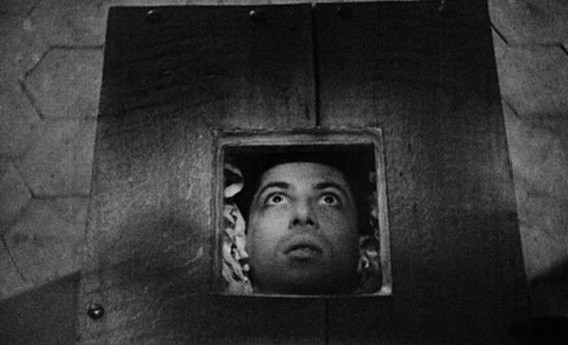
Slices of Life is a horror anthology film containing three stories, all directed by Anthony G. Sumner. Each story addresses an aspect of life--work, home, and sex--and are bound by a frame story in which an amnesiac girl starts to remember her own life.
Anthology horror movies are very difficult, especially on a low budget. The short horror film is a difficult craft in itself. Justifying the inclusion and order of the short films in an anthology often appears arbitrary. Sumner's approach shows a degree of thought and seriousness, as well as familiarity with the genre, that is of an unusually high order and these virtues are consistently present in each story.
The first, and best, of the stories, "W.O.R.M." concerns a sadsack mailroom clerk who uses experimental technology to make people be his friend. He's actually a rather likeable guy, thanks to a fine performance by Jack Guasta. But he has the misfortune of inhabiting a kafkaesque corporate office that rewards jerks and bullies exclusively. Sumner crafts this environment so expertly and believably that the eruption of a Cronenbergian sex-and-violence nightmare into this environment seems an appropriate and fitting end to its denizens.
The second story, "Amber Alert," is a well-crafted ghost story in which a pregnant woman begins to receive visitations from a kidnapped little girl. The outcome is a bit predictable and the telling too reliant on digital effects, though they are at times beautifully inventive. The depiction of an African American male may strike some viewers as either amusingly or lamentably racist.
The final story, "Pink Snapper," concerns a brother-and-sister duo who leave their abusive uncle and stumble upon a mansion in the woods where a girl is chained up in the basement and a body has been butchered in the bathtub. "Pink Snapper" is an excellently structured suspense-and-gorefest with a Hennenlotter sort of vibe. It works primarily on a visceral level, and it works very well. The practical effects in this segment are particularly praiseworthy.
The films are ordered almost like a work of classical music, the first movement exciting, the second slow and somber, and the third fast and playful. I found the momentum of the film highly engaging, making the heavily-allegorical conclusion, venial if a little misplaced. Sumner's work in each short is deft and thoughtful. It's a degree of
seriousness too often lacking in independent film. The stories and gore
are all consistently entertaining and thought-provoking, and the overall
design of Slices of Life is as elegant as the creepy scrapbook props of the
frame tale.
It's a shame that an independent, anthology horror film that's this good is so viciously trashed in its Internet Movie Database rating (3.7 at time of review). Slices of Life is what horror filmmaking is and a horror fan must be pretty jaded not to get some thrills from it.
Help make this site more interesting through discussion:
Slices of Life (2010) - 3/4
Author: Jared RobertsRosewood Lane (2012) - 2.5/4
Author: Jared Roberts Rosewood Lane is the latest film from Victor Salva. A vaguely supernatural thriller, it concerns the incessant harassment of a neighborhood by a teenaged paperboy. In particular, the paperboy becomes obsessed with Sonny Blake (Rose McGowan), a radio psychologist who has just moved into the house of her deceased father--who himself may have been murdered by the paperboy.
Victor Salva is always a complex filmmaker to approach, and not entirely for good reasons. Due to his unfortunate past, in which he sexually abused the boy star of his first film, Clownhouse, there is a tendency to look for biography in his work that may not be there--or, worse, to dismiss or express disgust with his work because of that past. Salva, however, is an undeniably skilled craftsman in the tradition of Spielberg, Coppola, and Hitchcock. Anyone ignorant of his past can enjoy his horrors and thrillers for the entertainment value alone. Nevertheless, Salva does have a tendency to personalize his films, a tendency often obscured by either unpleasant misreadings or pure enjoyment of the films. To do justice to Rosewood Lane, I will consider both the film's craftsmanship and Salva's personal expression.
Salva begins delivering the tension very early in the film. An elderly neighbor ominously warns Sonny against having anything to do with the paperboy. Salva compounds this advice with some eerie shots of the paperboy sitting stationary, on his bicycle, in the middle of the road, blocking the path of a moving truck. He's distant enough to be aloof from interaction, but the shots of him suggest he's watching and listening.
Soon, the paperboy is knocking at Sonny's door, and she's starting to notice objects in her house subtly rearranged. This begins an alternately suspenseful and infuriating cat-and-mouse game. The paperboy's seemingly supernatural speed and slipperiness, and his mystifying obsession with Sonny, give Salva the material to create considerable tension. The boy's smugness and abilities, however, can be infuriating. Had Salva not written Sonny as such a strong and intelligent character, this infuriating quality would have been tedious. As it is, however, our frustration is one we share with Sonny.
What ensues is really a power game to see who is going to dominate who. Sonny begins trying to reverse the cat-and-mouse roles by tracking down or chasing the paperboy. He manages to give her the slip each time with his apparently supernatural swiftness, even mocking her in some eerie setpieces. But she forces his hand to a final confrontation and a surprising conclusion.
Salva enriches the material somewhat by Sonny a past haunted by childhood abuse. The features of the house Sonny used to avoid abuse--basement, heating vents--become the features the paperboy uses to hurt her. There is a somewhat psychoanalystic sense of the paperboy being Sonny's victimized past returning to victimize her, a sense probably not intended except to create more emotional tension, at which it succeeds. Mostly, however, it strengthens our conviction that Sonny is tough and unwilling to let herself be victimized.
The character of the paperboy is, as noted, very dislikable. And his ability to outsmart or at least outrun everyone can create tedium. Sonny's aggressive nature mitigates this somewhat, because what we're really wanting is someone like her to 'teach him a lesson.' However, I think this is an instant where Salva's personal interests have triumphed somewhat over his craftsmanship.
What we observe in Rosewood Lane is a handsome, underage boy trying to worm his way into an adult's home and life, a boy who deliberately takes pleasure in showing what power he can exercise over adults. When he sits in front of the moving truck, for instance, or when he moves objects in Sonny's home; just being in her home or even the mere act of listening to her conversations, are ways he exercises power. (Listening is a relatively common technique children use on adults, especially foster children who need to feel in control of their situation more than most children.)
Knowing Salva's past as a convicted child molestor, it is difficult not to make something of this. But, in order not to be trite or glib, we have to be careful not to read in our own prejudices. The superficial reading would be that the film's dynamics represent a sort of allegory for Salva's own obsession. He struggles to lead a normal, respectable, and, due to his work, mildly public life, all the while he is victimized by this boy. The boy represents his own obsession with boys, and the boy's incredible sneaking powers shows how hard it is for Salva, how anywhere he turns the obsession may have slipped in unnoticed, much as how Jeepers Creepers II features a group of attractive, teenaged boys without shirts.
While that would be a fairly accurate picture of how such sexual addictions work, and while that may even partially describe what Salva is expressing, I don't think it exhausts it. I think Salva's mind is more complex and his vision more ambiguous.
The primary characteristic of the paperboy is his defiance, his need to express his own indomitability and his power over others. I don't think it's just the nature of addiction being allegorized in the narrative's action. I think, for the addict, the object of addiction is dominating and defiant. It exerts a power over the addict that he or she does not want it to do. This is true especially in one's fantasy life. And to pursue one's fantasies in the real world, as Sonny's pursuit of the paperboy, is doomed to failure.
I don't want to suggest Salva is cast into turmoil every time he sees a boy, but I do think the narrative presents a case of victimization by a boy that is akin to what someone like Salva may sometimes feel. That Salva's film releases have routinely been protested by his victim, Nathan Forrest Winters, adds another element to the idea of boy as dominant and defiant.
Reading more elements of the film into this sort of analysis would be possible. But I don't see the value in taking it any farther. Salva's films always seem torn between entertaining and expressing, and he always prefers to err on the side of entertainment. As he's quite good at creating suspenseful setpieces and his films have never yet failed to entertain me, I don't see a problem with that. Rosewood Lane is a suspenseful, fun film thanks to Salva's skill for thrills and McGowan's tough-but-vulnerable performance.
Categories: 2012, salva, thriller Sunday, September 2, 2012 | at 2:59 PM 1 comments
State of Horror Address: The Bad Horror Movie
Author: Jared Roberts It was Aristotle who stipulated that what makes something bad is failing at its function; and it was Jim Wynorski who retorted that what makes something bad is not having enough tits. But there's no such thing as 'enough tits,' so that definition is useless. And if the horror movie has any one function, I don't know what it is.
What I do know is there are some filmmakers who, like a Russian bride after the wedding, just don't care. They make movies for the same reason God makes yeast infections: just because. They make movies like they make bowel-movements, imagining no audience at all.
One such type of filmmaker is what I and his mother call 'the DeCoteau.' David DeCoteau's movies are made on miniscule budgets and guaranteed to turn profit by means of Netflix distribution deals. DeCoteau distributes these movies to put food on his table and cocks in his mouth. If he ever makes a good film, as he sometimes does, it is thanks to the screenwriter and Kamapuaa, the mighty Pig God of Hawaii. It's certainly not because he has any desire to keep you entertained.
Another type is the middle class white kid who's gotten so bored of World of Warcraft and not having sex, that he gets a few buddies together in mom's backyard to shoot a movie. Rather than concluding the result of his hobby, much like his Star Trek quilts and Naruto fanfics, is best hidden beneath his Final Fantasy 'doujinshi' porn comics, he decides to try distrubute it as a real film. This is possible thanks to indiscriminate distributors like Brain Damage Films, which carries the full oeuvre of virgins like Todd Sheets. Unless you're the 'director's' grandmother, these films offer you nothing. Like a smooth, prehensile turd, they're fun to make, but no fun to watch.
Some filmmakers really do care, however. But like true cowboys, they can't let you know they care. Quite the opposite, they go out of their way to make you think they don't care. They give their movies ostentatiously bad titles that impishly dare you to hope they'll be good, titles like, "Big Tit Schoolgirls in the Playground of the Dead," or "RoboPimp Flamethrower vs. the Bible Belt Hookers." Sometimes these titles, like Hollywood Chainsaw Hookers, Hobo with a Shotgun, and Schindler's List are a cue that you'll be getting cheaply-made, tongue-in-cheek entertainment. But often, the titles are the best part of the movie, as in the case of Bikini Girls on Ice. And this way, when their movie does suck, they can play dumb, DeCoteau, or dead, and say they weren't even trying.
Finally, there are the filmmakers who, unlike Rhett Butler, give a damn and an unnecessary urine sample. And often these filmmakers, like a clumsy but earnest lover, will hit the right spots and transport you to horror movie heaven. We're not interested in them now. We're interested in the earnest lovers who get us wet and sticky in the wrong places, and makes us laugh when we should be moaning; the heroes whose indelicate probing has caused me to beat the hell out of this metaphor. In this category we have our fertilizer salesmen like Hal P. Warren, who saw The Wizard of Oz and said, "I could do this with a broken wind-up Bolex and my knobby-kneed drinking buddy." And transvestites like Ed Wood who wrote the most epic sci-fi horror since Little Women and tried to make it with ten bucks and a 98% dead Bela Lugosi.
Yes, this is the category of filmmaker who is full of ideas and passion, so much passion it has to beat the crap out of know-how, talent, and common sense to make extra room. These are ideas so grand that they can only be realized with ineptitude. But from the cousins of ineptitude and pennilessness come the inbred children of strangeness and uniqueness. Plan 9 from Outer Space, Troll 2, Manos: The Hands of Fate, The Chooper, Blood Orgy of the She-Devils, and, of course, Intercessor: Another Rock 'n' Roll Nightmare are bad movies, but brilliantly entertaining in their earnest zeal to excite, shock, and terrify with stuff that isn't remotely exciting, shocking, or terrifying.
At the end of the day, the beginning, even sometimes during the middle of the day while eating a sandwich, horror fans are an accepting crowd. Yes, we ask to be entertained, sometimes shocked, frightened, horrified, maybe even intellecually engaged--but really, the bare minimum we ask is some passion. When the filmmakers don't even care--and we know, not through our ubiquitous bathroom cameras, but through intuition--that's what makes a bad horror film. We just want to know you love us. You don't have to say it; we just have to feel it.
In memory of Ray Dennis Steckler
Categories: address, steckler Monday, August 20, 2012 | at 1:38 PM 1 comments
State of Horror Address: Teagan Clive
Author: Jared Roberts Some things just inspire poetry. The acts of great men have inspired Homer in The Iliad, and Walt Davis in Sex Psycho; the beauty of nature inspired Wordsworth's "Rain Cloud" and Max Hardcore's "Peeing in a College Girl." Teagan Clive is one such entity. I have had the opportunity to see her twice and feel she's strong in the Force once. Both times I've seen her has been in b-movies, and each time she had even less clothing than they had plot. One is Interzone (1987) by Deran Sarafian, the other is Alienator (1990) by Fred Olen Ray.
Teagan, if you've yet to encounter her in her brief cinematic oeuvre, is a modern, powerful woman. I don't mean powerful like Hilary Clinton, but more like the sasquatches of the WNBA. She has an immaculately-sculpted, muscular body that nears the boundary between "sexy aerobics instructor" and "where's the penis?" but keeps on the good side. Unlike many female body builders, her face does not resemble Jackie Chan's left foot or a frozen mop, but rather retains its voluptuous femininity. Her beauty is a strange but striking combination of the Grecian and the Californian ideals, except heterosexual.
Armenian director Deran Sarafian knew that for his epic second feature, Interzone, a post-apocalyptic action adventure, he required the inspiration of a Homer and the visual splendor of the Sistene Chapel--but for only $2000. Thus was Teagan cast as Mantis, the sociopathic warlord who is constantly posing for an unseen Sports Illustrated shoot. Opposite Teagan is Bruce Abbot, a smug cross-breed of Bill Pullman and Elias Kotias. He plays Swan, a wheelin' dealin' douchebag who gets by on wisecracks and streetsmarts, like a white Morgan Freeman. But this descendant of Indiana Jones and Pinocchio is drawn, as all heroes must be, by love and prophecy into saving the treasures of the Interzone from Mantis.
Interzone is an immensely fun movie that will do for your brain what a bubblebath does for your anus. But the highlight of the movie, and not coincidentally, the most Teagan-filled sequence, is--like the cleansing effervescence of my Ninja Turtles bubblebath--when Swan decides he must seduce Mantis to defeat her. As in real life, this triggers a five-minute montage of Teagan posing in silhouette while a band of harpists play an endlessly looping tune of about five notes. Once the posing is done, Teagan graduates, as any warm-blooded woman with Bruce Abbot would do, to blindfolding him then hand-feeding him bananas and sardines.
What I'm saying is not just that Teagan happened to partake in this playful, creative, charming scene like a fat kid in gym class. I'm saying that that scene could no more be conceived without Teagan than the Gospels could without the Jesus, or the Mona Lisa without the prostitutes. The scene is composed from Teagan's unique features: her exquisitely-honed female form with its intimations of power even greater than William Shatner's testicles; her seductive femininity with its subtle vulnerability, not unlike a kitten with a shotgun; and her playful expression of sexual desire. What makes Teagan so extraordinary is that, like a cheesecake, she makes contradicting features complementary.
In Alienator, Fred Olen Ray, like an Asian parent, takes these features of Teagan's and pushes them farther. Much like Crime and Punishment, Alienator is about a space criminal who escapes to earth. The Alienator is not, as Marx argued, the capitalist wage system, but rather a cyborg entity sent to retrieve the space criminal. Combining nearly-invincible super-strength and cosmic destructive powers with a highly-toned female physique, the Alienator can only be played by Teagan--with due apologies to Ernest Borgnine's supporters.
Just as in Interzone, there is one sequence of Alienator in particular that both encapsulates and is directly inspired by Teagan--a Teaguence, if you will. In Alienator, it's a single shot of Teagan, in her full space armor as any self-respecting Alienator must be, reclining against a tree. She holds out her hand to a deer, perhaps grieving a dead mother--we just don't know--and it comes to her without fear or even lust. The shot combines the physical power of Teagan's physique with the opposing tenderness in her femininity; the Alienator's destructive potential with her gentleness toward the innocent and harmony with nature. In doing so, it almost spiritualizes these features, not unlike Patrick Swayze in Ghost; and it achieves a photogenic sublimity--photogeneity being, according to Delluc and Epstein, the very essence of cinema.
Perhaps you will think I'm going too far. But there is no denying the real importance of the photogenic in cinema. And Teagan's body and elegant movements are powerfully photogenic, leading to unforgettable moments of fun and charm in what could have been forgettable movies. I don't know where Tegan is now. She, like Sylvester Stallone and Matthew Broderick, has not acted since 1990. But she was a b-movie Muse while she was active, and her few contributions deserve this long overdue recognition.
P.S. Come back, Teagan!
Categories: address, fred olen ray, humour Monday, August 13, 2012 | at 5:19 PM 3 comments
State of Horror Address: The New Wave of French Horror
Author: Jared Roberts The French first surrendered to horror only a short time ago. Like a furious Napoleon, but with even more DVD sales, they raged overseas and made passionate love to American markets. And we embraced them, because their horror films were the moist, nay excrementally runny camembert to our hard and mouldy cheddars. But now we've forgotten about them like an uncle's unwanted touches. Has the Muse left them to star in a Japanese bukkake video? Has their inspiration run drier than Charles de Gaulle's foreskin? Or do we just have the attention spans of an epileptic monkey? Let's find out what made this phenomenon even shorter-lived than existentialist bellydancing.
Even under the dictatorship of Jerry Lewis, there were French horror movies before High Tension (2003). But no-one in France could find the right red wine to accompany them, so they gave up. Finally, when the young Alexandre Aja fermented a Dr. Pepper, the New French Horror Film was born. With High Tension, the tasteless fish roe of Dean Koontz was so smothered with the Heinz Ketchup of gore, Americans had no choice but to eat it. Even before we'd swallowed the last spoonful of delicious Koontziar, Aja was letting us know it was a meaningful, lesbian love story all along. And his snobby, French accent was so compelling, nobody even minded the plot hole the size of Dean Koontz's mustache.
Aja left France and, like Napoleon before him, dedicated himself to fun and gory remakes. But his massive, French balls had already done their damage in Paris. Like the leader of a gangrape, he set the model for what was to come.
Pascal Laugier's Martyrs (2008), a film originally intended as a Bible epic follow-up to The Passion of the Christ (2004), is the most remarkable and extreme of the lot. Laugier took all the elements that made High Tension a charming Pepe Le Pew--things like character depth and suspense--and flushed them down the nearest street urinal. What remained was a gory, disturbing, and fun-free pure Pew. But he dowsed that Pew in enough pseudo-intellectual, self-important cologne, that we ate it up like a deep-fried eclaire, reminding us of Descartes's dictum, "I make you think I'm smarter than you, therefore I am."
But where Descartes failed, Xavier Gens succeded with Frontier(s) (2007). Because Gens took all that made High Tension fun, but channelled it directly at the American cinematic prostate that is Nazi-hatin'. And the 's' in parentheses informed us that the gallons of inbred, Nazi blood actually means something. That's what we loved about these movies: they weren't content to just give us backwoods, inbred maniacs butchered with buzzsaws; they gave us backwoods, inbred maniacs butchered with ideas.
More idea-butchery was going on in Fabrice du Welz's Calvaire (2004). So much so, no-one even noticed it's really a Belgian movie. Like a Louis Quatorze chaise, but with even more bestiality, Calvaire brought psychosexual profundity to the backwoods rape-torture movie. And, taking a page from Gerard Depardieu's autobiography, du Welz made his backwoods, gay rape respectable with Biblical motifs.
But not all French horror movies are inflated bags of Sartrean nothingness. Some are filled with Sartrean party favors instead. Sheitan (2006), for instance, reminds us that French, inbred mutants can be just as fun as American, inbred mutants--and they can milk a goat even better. A l'interieur (2007) shows us not only the Italians have the cajones to carve out a fetus. And in Ils (2006) we find out French kids are every bit as shitty as our own. But most importantly, each of these films offers more tension than Marie Antoinette's cakehole, and at least as much unpretentious gore as Gerard Depardieu's wedding video.
So why have we forgotten them like a Polanski rape charge? Because their commitment to the genre was flimsier than a soggy baguette? Because the few Frenchies still doing horror surrendered to American producers faster than they could say, "Jessica Biel"? Because we got tired of subtitles, so we're just gonna watch SyFy? Or because Japan and Korea are offering the same deal, but with more substance, plus a guarantee to commit seppuku in shame if we find their films dishonorable? Quicky: Yes, Yes, No, and Yes--not to be confused with the Japanese bukkake video of the same name.
To be fair, there are still five people who believe the French make the best horror movies. And someday they may be rewarded with the Even Newer Wave of French Horror that will deluge them in buttery, gourmet horror treats. For now, the Wave has crashed in some kelp-choked sputters that sounded vaguely like, "La Horde," "Mutants," and "Jerry Lewis, pardonez nous." As of August, 2012, all hopes rest on Marina de Van, a film I haven't seen called Livide, and the long-delayed release of Jerry Lewis's The Day the Clown Cried, the goriest, most disturbing Holocaust film ever made. Until then, we'll just have to remember the Wave fondly and enjoy its treasures for what they are: a series of thrilling gorefests masquerading as art films.
In memory of Jean Rollin.
Sunday, August 5, 2012 | at 6:38 PM 0 comments