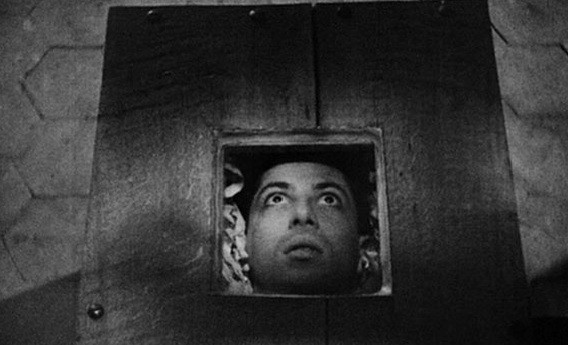
The Box Collector tells an eccentric, melodramatic story about small town people. I think this is supposed to mount up to some statement about jealousy. The basic plot concerns the very sheltered but handsome young Harry (Noah Segen), who likes to paint pictures of boxes. He is falling in love with a sexually provocative and exotic new neighbour, Marie (Lyne Renee). Working against this love is all the men in town who also seem to be falling for Marie and, most importantly, Harry's eccentric and potentially-dangerous mother Beth (Margot Kidder). As the story plays out in this peculiar small town, though, it goes far beyond a statement about jealousy. It becomes a grand expression of a perverse worldview I find deeply fascinating.
It only takes five minutes for this worldview to begin to show itself. As Harry enters the pharmacy to collect medication for himself and his mother, he's immediately set upon by the slutty cashier. She leans forward to flash as much of her ample cleavage as possible, asks Harry why he doesn't come around more often, and drops several subtlety-free clues that she wants him. On his way out of the pharmacy, Harry's friend Burt invites him for a drink at the bar, where it's made clear the slutty, sexy female bartender is into the virginal Harry. When Harry gets home, the beautiful and provocatively-dressed Marie, possibly a slut, is moving in next door and immediately takes a shine to Harry, making a show of her assets.
You may be wondering why I keep using the word 'slutty.' Surely I'm being a chauvinist scumbag? No, I'm just interpreting what is given on-screen. Burt makes clear the bartender will put out for anyone who pays. Similarly, the pharmacy cashier later wastes no time going for a ride with Burt. Even Marie is a 'massage therapist' by night, working in her own home. She's also perpetually flirting with all the town's men.
To be frank, the worldview being put forward here is that all attractive, young women are sluts. It gets better, though. You can't have sluts without slut-hungry men. And sure enough, all men who aren't Harry fall into the category. They are mostly represented in the character of Burt, however. Men are looked upon as incapable of fidelity; and due to the overwhelming number of sexy sluts in town, it's easy for them to cheat. Burt's wife Luz is both menacing and comic relief as his fiercely shrewish shadow, following his every move, just knowing he's adulterous. Beth, it turns out, is Luz's best friend. They spend all day reading tarot cards and bitching about how men can't keep 'it' in their pants. Beth herself was the victim of infidelity and despises all men who aren't her son.
The plot thickens further. Marie is on the run from her ex-husband with her daughter. She keeps complaining about how jealous he was because she was constantly giving massages to other men and flirting. She makes clear jealousy is something she can't stand. Of course, there's a difference between jealousy and not wanting to be humiliated. In this perverse world the filmmaker has set up, one can hardly blame her ex-husband for having been worried. But I digress.
The point of fact is that this bizarre worldview is very fascinating. It basically compartmentalizes all men into two categories: virginal mama's boys and horndogs. And it compartmentalizes all women into two categories: man-hating harpies and shameless, sexy sluts. It's not entirely clear which side the film stands on. It seems to regard with amused condemnation all of these categories. Marie and Harry alone offer some possibility for being a normal, happy, faithful couple in this twisted universe.
The worldview here is the polar opposite of what one finds in Russ Meyer's films. The ultimate expression of Russ Meyer's philosophy, Ultravixens, boils down to one oft-repeated line from the film, "Always look a good fuck in the face." The Box Collector is not appreciative of that philosophy.
So much for worldview. There are other things to enjoy in the film. The grotesque characters who embody the odd worldview are certainly fascinating and amusing to spend time with. They feel like real people. I grew up with people like this. However odd or caricatured they may seem to some, they're real. The most potent of the characters is Beth. Not only is she a complex woman with strong and frightening feelings, but Margot Kidder gives a totally uninhibited performance as this grotesque character. It is truly incredible. One would expect Kidder to be interested in preserving some glimmer of her sexpot image. She let's it all go. She wears huge glasses, hair so dry it might as well be seaweed, frumpy fortune teller clothes, and hobbles with a cane. Close-ups emphasize the wrinkles around her mouth as she delivers frightfully-impassioned lines or cold lines hiding the fire within. Apart from Beth, Luz (Adriana O'Neil) is a scene-stealer as the bitter, jealous harpy. The past-their-prime ladies definitely take control of this movie and show the men and sexy young women a thing or two.
As I mentioned, there is a problematic final three minutes. It calls into question most of the rest of the movie. There is something to figure out there, but I'm not convinced it's worth puzzling out. There is scarcely enough information given and even once one does puzzle it out, it won't reveal anything more about what the film has to impart: the strange worldview remains pretty much what it is. All it might do is serve to distance the worldview from the filmmaker, well-known British producer John Daly, who the end credits tell us wrote and directed the film. Daly passed away in 2008, before The Box Collector had a chance to get out. I wonder if the ending was his decision? At any rate, the film remains an emotionally powerful, fascinating picture that will offer plenty of entertainment for lovers of peculiar characters.
Help make this site more interesting through discussion:
The Box Collector (2008) - 3/4
Author: Jared RobertsA Closed Book (2010) - 3/4
Author: Jared RobertsHans Holbein's The Ambassadors is the centerpiece of Raul Ruiz's new and frankly unexpected thriller, A Closed Book. The image is famous for being the height of perspectivist painting. It depicts two elegantly-dressed ambassadors standing on either side of the frame. Between them is a skewed skull, which the viewer may only see by gazing at an angle. Standing front-on, the skull looks like a mistake, a stretched object of unrecognizable form.
In the two-person drama of A Closed Book, both characters are unable to recognize the threat they present to each other, to see the skull that stands between them. Their perspectives are wrong, too limited by each their own motives and histories. These characters are Sir Paul Napier (Tom Conti), a highly-respected art critic now old, retired, and left eye-less due to an accident; and Jane Ryder (Daryl Hannah), an art student who has just acquired the job of being Paul's amanuensis for writing his final book, his autobiography, titled A Closed Book.
Ruiz achieves a sympathy shift at about the thirty-minute point in this film that is difficult to achieve at all, let alone so smoothly. I began by assuming the gentlemanly, but very frank Paul with his eccentricities and occasional lack of patience is playing a perverse game, like a villain in a John Fowles novel. Soon, however, little clues start showing that Paul may be the victimized, not the victimizer. In subtle ways, Jane expresses contempt. She stands before him totally nude as he bathes. He can't see her and she's not merely using the opportunity to get some nudism out of her system: never has such a beautiful body been such an expression of contempt. It is an act of disrespect and humiliation, though he'll never know. The observant viewer will also notice Paul's paintings getting turned upside-down and objects mysteriously displaced. He doesn't know, so what's the point? Sheer contempt.
Were that contempt an anomaly, not unlike the disappearing girls in Picnic at Hanging Rock, I think A Closed Book would be a stronger film than it is. I can't resist saying A Closed Book would have been better left open. The film offers a resolution, an explanation, that debases the film somehow. It does complete the Ambassadors motif, however, as both characters spell a certain symbolic death to one another, when finally they exchange perspectives.
Of course, a Raul Ruiz film can be enjoyed in nine and sixty ways "and every single one of them is right." You can ignore the plot and just soak up the melodramatic atmosphere and Ruiz's very visible direction. You'd almost think he's been watching Mario Bava films, for all the showy moves. You can also enjoy getting into Paul's complex mind. He's certainly no stereotype eccentric grump. He's a complicated man with a sense of dignity and generosity whose eccentricity comes out of genuine depth. Jane is a complex character herself; she's certainly not a mere fury a la The Hand that Rocks the Cradle. Her conscience shows through in just how often she apologizes. The performances are also enjoyable, being so suited to this very Anglo-Saxon mode of melodrama, at times very real and at others justifiably hammy. It's not so much the actors that are hammy as the characters. Or you can just enjoy the art-filled set. Or the slow, deliberate moments, like when Paul's housekeeper tries to figure out The Ambassadors and when he tells her a story about his youth.
I certainly enjoyed spending time in A Closed Book, though it is in some ways vapid, obvious, even pompous, and weakened by its closed ending and sometimes heavy-handed symbolism. In other ways, perhaps it's none of those things. It's a matter of perspective.
Categories: 2010, arthouse, thriller Sunday, February 28, 2010 | at 2:21 AM 0 comments
Scooby-Doo: Abracadabra Doo (2010) - 3.5/4
Author: Jared RobertsYou can find some real gems in the strange world of straight-to-video cartoons. Take this new Scooby-Doo adventure, for instance. It's inventive, funny, and has some great locations and interesting faces--this is just what cartoons should be. Most kids don't want sweeping, theme-laden Disney epics for brisk entertainment: it's just too exhausting with its drama, music, and character development. Abracadabra Doo has the immediate-gratification and inventive powers of a Tex Avery cartoon along with its fun mystery story. Both kids and adults can appreciate that.
The story concerns Velma's younger, cuter sister, Madelyn. She's studying at a magic school. Now before ol' Hagrid pulls the Harry Potter bells in your head, this is genuine magic, as in conjuring, with David Copperfield. Even the owner of the school, Whirlin' Merlin, sports tight black pants, a flowy shirt, and long blond hair: he's ready for a magic act 24/7, as is his sexy assistant. Anyhow, a griffin has been terrorizing the school and scaring everybody away, so Mystery Inc. shows up in their mighty van to look for clues. Always looking for "clues", those guys. You don't hear much about 'clues' in real detective work anymore; I don't recall the word 'clue' ever being used in an episode of CSI. But I'm getting off track. At the same time the griffin is attacking, an icecream tycoon, Calvin the Cone King, is trying to buy the beleaguered castle from Merlin. The gang have to investigate the history of the castle to find out just where the griffin is coming from and why.
There is an entertaining cast of characters here. Of course the mystery gang is always entertaining. Frank Welker is great voicing Scooby and Fred, and Matthew Lillard does Shaggy himself. They're all on form here: it feels like the same gang I grew up watching, possibly even better. As to the supporting characters, Merlin is always pulling doves out of the unlikeliest places and appearing in vaguely sexy magician poses. His brother Marlin is Brian Posehn, in character design and voice. Sadly they don't let him do any of his jokes about the taste of semen. Instead he invents machinery to do better magic tricks. There's a very butch maid. A creepy groundskeeper always wielding that menacing pitchfork. The snooty ice cream guy always trying to make his real estate deal. They're all kinda suspicious and all amusing to see on screen, especially given Shaggy's and Scooby's reactions to them.
The jokes work for either adults or children. The animators and the writers are always finding interesting ways to exploit the setting, the situation and the characters for a few laughs. Some of the comedy seems to come down to an amusing phrase, like, "Won't somebody dab up this dairy?" I'm not sure why, but the alliteration of the sentence and the way it's delivered is quite funny. It's not even a punchline. There are also jokes using GPS and iPhones. It's a modern world. It should keep the whole family entertained, at any rate.
As to the scares, looming old towers in misty lakes with fierce griffins and screeching banshees set the spooky tone. For adults, this is fun and makes for great atmosphere. For children, this might offer some suspense and mild scares. Possibly it'll work as both a scary movie and a comedy for the kids, which is just what Scooby Doo stories are supposed to do. As an adult, I liked Abracadabra Doo very much; as a kid, I would have loved it.
Categories: 2010, animation Friday, February 26, 2010 | at 12:58 PM 0 comments
The Perfect Getaway (2009) - 3/4
Author: Jared Roberts'The Perfect Getaway' is a title with two meanings, one referring to the murderous couple who have found a clever means of escaping detection; the other the island paradise of Hawaii on which the murderers are occurring. You don't get a lot of Hawaii-set horror/thriller movies. I can only think of a the mediocre trash novel, Fires of Eden, by Dan Simmons. On the cover of the paperback, Stephen King's blurb is 'Dan Simmons writes like a hot-rodding angel.' Personally I think he writes like a gimpy sheep with cataracts. But I'm getting discombobulated here. The point is, Hawaii is a great place for horror, if only because it's so beautiful and innocent it really catches you off-guard. Thankfully David Twohy takes us into that rare territory.
We follow a couple, nerdy Steve Zahn and girly Milla Jovovich (we believe that, don't we?), as they decide to take a hike to a less accessible but truly unsullied portion of Hawaii for their honeymoon, anxiously aware of the presence of a psychotic couple on the island. Along the way, they give the slip to a trashy hitchhiking couple and becoming traveling companions of a rather intense ex-special ops man (Timothy Olyphant, doing an incredible job) and his girlfriend. The odder Olyphant's behaviour seems, the more suspicious are aroused that he just might be a murderer. But then again, maybe it's that trashy couple who seem to keep tailing them. From Zahn's skiddish point of view, it could be either one.
Even though most of the film is given from Zahn's and Jovovich's point of view, with Olyphant's point of view interjecting once towards the middle during Zahn's bathroom break, curiously I found myself wanting to spend the whole time with Olyphant. The screenplay is written in such a way as to make us see how Olyphant might well be intense and a bit intimidating, but at the same time he's nice and a really cool guy. Yet Zahn is perpetually unpleasant with him and telling Jovovich how creepy Olyphant and his girl are. Zahn's character comes off as a pampered, xenophobic jerk and Olyphant a genuinely interesting, friendly person who lives life his own way. Another curious thing is that I'm fairly certain this is intentional: we're supposed to be both attracted to Olyphant and slightly sharing Zahn's apprehensions; and we're supposed to see Zahn is a bit of a jerk, even while his concerns aren't unjustified. It's very clever writing.
Twohy is a screenwriter-director I've long respected. I adore The Arrival, possibly the most entertaining alien invasion movie ever made. There is little question that The Perfect Getaway is just as well-made as The Arrival in terms of narrative coherency, entertainment value, and visual power. There are a lot of beautiful moments, as well as fun references for the film buff. There are, however, some problems.
The big problem is a matter of narrative. When you have an omniscient narrator, information cannot legitimately be withheld. Any information an omniscient narrator has that occurs within the timespan of the story's action must be laid out before the audience. In order to withhold information, we must either remain entirely with one character, effectively limiting the omniscience; or the narration must be subjective. In literature, this would be first-person narration. In cinema, this is usually accomplished via a 'subjective camera'. As I mentioned, we do get both Olyphant's and Zahn's perspectives at some point, so we do have an omniscient narrator. This means Twohy is cheating. But it gets worse. For the big reveal in the film to work, those withheld elements have to be recalled as well as some events prior to the time the story begins. That's legitimate. The problem is that nobody is actually doing the recalling! The narrator just suddenly spills it out before you as exposition. Well, if it could do that all along, why didn't it do it at the beginning? Just to make the surprise. And that's cheating. You don't find that in Hitchcock's films.
I don't imagine for a moment I can teach David Twohy anything. But everybody makes mistakes and that's one he made: The Perfect Getaway has point-of-view problems. Is it very damaging for the film? No, not really. It's still an entertaining story told with style. I was particularly interested in how Twohy edited the climactic chase scene to include not just fast cutting, but even split-screen effects of the same shot to give a fractured, hyperkinetic feel to the action. I don't recall having seen that in any other film; however, I don't watch many action films.
Categories: 2009, thriller Thursday, February 25, 2010 | at 7:03 PM 0 comments
Upstairs (2009) - 1.5/4
Author: Jared Roberts'90s heartthrob Luke Perry costars in Upstairs, a thriller in which he plays a psychotic, uncouth man who takes an apartment at the mansion of a blind woman. The focus of the film is actually on the blind woman, Grace (Kelly Harrison), who rents the place as a means to pay off the mortgage on the mansion she's inherited. Her parents and her eyesight were all lost in a car crash. Perry seems like a nice guy, but he soon starts annoying her with loud music, prostitutes he pays for sadomasochistic games (so screaming), and just being generally creepy by coming into her part of the house and messing with her stuff.
Upstairs is an extremely formulaic film. It is so by-the-numbers that it's really embarrassing to see this film had any writer at all, let alone two screenwriters. If you could make a kit called "Write Your Own Terrorize-a-Blind-Woman Story" Upstairs is precisely what it would produce. Every little detail is mechanically set up for later in a tidy package. For instance, we get a scene of Grace counting her way to the fusebox and sure enough she uses this later to get the advantage of blindness. The whole movie is made up of such moments.
Usually the best part of a terrorize-the-blind-woman movie is the actually terrorizing moments and when she finally decides to get the upper hand. The problem with this film is that Grace is a real bundle of nerves, gittering, always gasping and startled. She's so irritating! As big a jerk as Luke Perry is here, you almost side with him she's such a nuissance. We get it: she's blind. It doesn't mean she's a fricken puppy! She makes so many little gasping and whimpering noises constantly that I wanted to muzzle her. Okay, so maybe that really is supposed to be her character: maybe she's just a jumpy person. But it sure makes her tiresome to be around. The worst thing is, she reminds me of myself in some ways, the way she becomes infuriated by the least inconsiderate behaviour from the tenant and allows it to spoil her day. It's that grey area where he's in his rights but still ought to be more considerate that always infuriates me as an apartment dweller.
The best part of the film is Luke Perry, who is actually extremely creepy as the mannerless psychopath. He just has no sense of shame and that makes him creepy. There's also a little girl, Stella Pejo, who's surprisingly good in her role as Grace's helper/music student. And these cops who become progressively annoyed with Grace's constant calls--they're the most human people in the film. Really, I don't blame them for getting annoyed.
The direction is best described as classy. Robert-Adrian Pejo (any relation to Stella?) directs the utterly trite story with elegance, a certain detached elegance. Why detached? Well, he probably knew how trite the story is himself. Anyhow, if Upstairs passes on television and you have nothing better to do, it's worth leaving on; but don't make an effort to see it.
Categories: 2009, thriller Wednesday, February 24, 2010 | at 2:45 PM 1 comments